

Robotics Piano Bold Free icon download
Download all to grab every PNG variant.
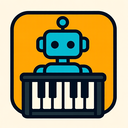
The icon in question is a powerful, visually striking representation that masterfully blends the futuristic essence of robotics with the timeless elegance of the piano, all rendered in a bold and commanding design language. This icon is not merely decorative; it serves as a symbolic bridge between two seemingly disparate worlds—technology and art—illustrating how innovation can harmonize with creativity. At its core, this image captures a robotic figure poised at the heart of musical creation, embodying both mechanical precision and emotional depth.
The central element of the icon is an abstract humanoid robot, designed with sharp geometric forms and angular lines that convey strength and modernity. Its body is composed of interlocking metallic panels in deep charcoal gray and steel blue hues, with subtle gradients suggesting a high-tech alloy surface reflecting ambient light. The robot’s torso features a prominent control panel resembling a piano keyboard embedded into its chest—this integration is not incidental but symbolic, highlighting the fusion of digital intelligence with musical expression. Each key on this internal keyboard is represented by bold, rectangular blocks that glow faintly with an electric blue pulse, symbolizing data flow and computational energy.
The robot’s arms are articulated for maximum mechanical functionality: the left arm ends in a sculpted hand modeled after a pianist’s fingers, but constructed from polished chrome and layered circuitry. The right arm is slightly more abstract—instead of fingers, it terminates in four thick, segmented robotic digits that resemble piano hammers, each one striking a phantom key with precision. These components are designed with an unmistakable boldness: every edge is sharp-edged and defined, every contour deliberate. The lines do not taper or soften; they remain assertive and impactful even at the smallest scale, ensuring legibility and presence on any device or display.
What elevates this icon beyond a simple juxtaposition of elements is its artistic symmetry. The robot stands in a dynamic yet balanced pose, as if mid-performance. Its head tilts slightly forward, with two large optical sensors (resembling glowing piano keys) for eyes that emit a warm amber light—this gentle contrast against the cool metallic tones adds humanity to an otherwise mechanical form. The neck is reinforced with visible joints and servos, suggesting both strength and flexibility, while the back reveals exposed internal wiring shaped like musical staff lines—a clever visual metaphor connecting data pathways with sheet music.
At the robot’s feet, a stylized piano emerges from beneath its posture. It is not a full-scale instrument but rather a conceptual representation: only three octaves of the keyboard are visible, rendered in sleek black and white blocks with thick outlines that echo the icon's bold aesthetic. Each key is oversized and slightly raised, giving the impression of being physically pressed by robotic fingers. The piano’s frame appears to be formed from industrial steel beams fused seamlessly with musical symbols—quarter notes, sharps, and natural signs subtly carved into its sides. This fusion reinforces the theme that robotics isn’t replacing art but enhancing it.
The color palette further enhances the icon’s bold character. Dominant shades of black, gray, and deep blue provide a strong foundation that evokes industrial strength and technological sophistication. However, key accents—such as the pulsating blue of active keys and the warm amber glow from the eyes—break through with emotional resonance. These highlights are not subtle; they command attention, ensuring that even in small sizes or low-resolution displays, the icon remains vibrant and legible.
Typography is absent from this icon—but its absence is intentional. The focus remains entirely on visual metaphor and symbolic depth. There are no labels, no words: the design speaks for itself through form and structure. This minimalist approach amplifies the boldness of each line, shape, and color choice.
Ultimately, this icon stands as a testament to the evolving relationship between human creativity and artificial intelligence. It declares that robotics is not cold or soulless; instead, it can be deeply expressive—capable of interpreting emotion through sound. The piano becomes more than an instrument; it transforms into a language of feeling encoded in binary logic and mechanical movement. And through its bold design language, the icon refuses to be overlooked—it asserts its presence with confidence, reminding us that innovation and artistry are not enemies but partners in progress.
In a digital world saturated with soft edges and muted visuals, this icon dares to stand out. It is unapologetically bold in form, deeply rooted in the themes of robotics and piano, and ultimately unforgettable—a visual statement that technology can play music as profoundly as any human.
Create your own icon with our GoGPT AI prompt:
GoGPT