

Robotics Piano Futuristic Free icon download
Download all to grab every PNG variant.
```html
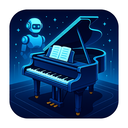
The icon embodies a revolutionary fusion of advanced robotics, classical musical artistry, and visionary futuristic design. At its core lies a meticulously crafted representation of a piano that transcends traditional boundaries—transforming from an instrument of acoustic elegance into a dynamic centerpiece of technological innovation. This icon captures the harmonious convergence between human creativity and machine precision, symbolizing the next evolutionary step in musical expression where artificial intelligence collaborates with artistic intuition.
The piano itself is rendered with sleek, angular lines suggestive of advanced materials—possibly carbon-fiber composites or self-repairing nano-alloys—that shimmer faintly under digital light. Its body is streamlined like a high-performance aerodynamic vehicle, yet retains the familiar silhouette of a grand piano: elongated form, gracefully arched lid that appears to float above the keyboard, and elegant legs resembling slender titanium pillars. However, instead of wood or traditional metal finishes, this piano exhibits an iridescent surface that shifts color subtly depending on viewing angle—pulsing from deep cobalt to radiant silver as if breathing with digital life.
What truly defines the icon’s futuristic character are the embedded robotic elements seamlessly integrated into its structure. Along the edges of the keyboard, micro-actuators extend like crystalline filaments, each capable of independent movement—adjusting key pressure and timing at nanosecond precision. These robotic fingers are not mechanical arms in a conventional sense but rather transparent, liquid-metal tendrils that appear to be made from a semi-organic plasma substance. They hover slightly above the keys, pulsing with bioluminescent light patterns that mirror the rhythm of an emerging melody.
At the heart of this fusion is a central AI interface—a floating orb positioned just above the keyboard, suspended by magnetic levitation. This holographic core glows with soft cyan and magenta pulses, displaying real-time music generation algorithms. It projects intricate three-dimensional waveforms that respond to ambient sound or neural input from a nearby musician's brainwave sensors (as implied by faint neuro-circuit patterns glowing on the piano’s base). The orb can interpret musical intent not just from finger placement but from emotional resonance—detecting sadness in a pianist’s touch and automatically adjusting harmonic progression to reflect melancholy with synthetic strings and ambient synths.
The keyboard itself is a marvel of responsive technology. Instead of traditional wooden or ivory keys, each key is composed of transparent, pressure-sensitive polymer discs that emit their own soft light when pressed. The illumination varies in hue depending on the note—blue for low C, crimson for high E—creating a visual symphony that accompanies every performance. Beneath each key lies a micro-robotic assembly capable of autonomous reconfiguration: the piano can dynamically shift its tuning system, switch between historical keyboard layouts (like harpsichord or clavichord), or even create entirely new scale systems based on quantum algorithmic composition.
The futuristic aesthetic is further emphasized by subtle environmental integration. The piano sits atop a circular platform embedded with glowing circuitry that pulses in rhythm with the music, creating a halo of light around it. This platform isn't static—it subtly rises and lowers during performances, as if breathing in time with the composition. Around it float ghostly holographic notes that linger mid-air after being played, forming temporary geometric patterns reminiscent of digital constellations.
Even the piano’s lid is a mechanical masterpiece. When closed, it becomes a smooth expanse of reflective surface reflecting ambient light like liquid mercury. But when opened, it unfolds with silent grace—retracting into the frame like origami made from quantum glass—and revealing not just a standard soundboard but an intricate lattice of internal micro-robots that analyze and amplify sound waves in real-time, enhancing tonal clarity with adaptive resonance technology.
Symbolically, this icon represents more than a mere instrument—it stands for the future of human-machine collaboration. It embodies the idea that technology does not replace artistry but enhances it, providing tools for composers to explore musical dimensions previously unimaginable. The robotic elements are not cold or sterile; they are designed with fluid grace and expressive motion, suggesting emotional intelligence in machines. The piano’s futuristic design reflects progress without sacrificing elegance—where innovation is not a departure from beauty but a continuation of it.
Ultimately, this icon captures the essence of robotics through its intelligent systems and autonomous components, celebrates the piano as both heritage and evolution through its expressive keyboard and acoustic capabilities, and embraces futurism in every detail—from materials to interface to dynamic behavior. It is not just an image of a machine playing music; it is a vision of harmony between humanity, art, and technology in the 22nd century.
```Create your own icon with our GoGPT AI prompt:
GoGPT