

Robotics Piano Simplified Free icon download
Download all to grab every PNG variant.
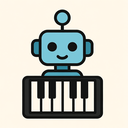
The icon embodies a harmonious fusion of three distinct yet complementary concepts: robotics, piano, and simplified design. At first glance, the icon appears minimalist—a clean silhouette that captures attention with its elegant restraint. However, upon closer examination reveals a profound narrative woven through geometric precision and symbolic abstraction. This is not merely an image; it is a visual poem about technology meeting art in a world striving for clarity.
At the heart of the icon lies a stylized representation of a piano keyboard. Yet, rather than depicting the full 88 keys with intricate detail, only four to six key shapes are present—simplified into smooth rectangles with subtle gradients suggesting depth and dimension. These rectangular forms are arranged in alternating black-and-white patterns, but the lines between them are blurred into soft curves, minimizing visual clutter. This deliberate choice speaks directly to the "simplified" aspect of the icon: every element has been reduced to its essential form without losing recognition or meaning.
What makes this piano representation truly innovative is its integration with robotic elements. Instead of a traditional wooden frame, the keyboard appears to be part of a mechanical structure—perhaps an armature or chassis that supports it. The base beneath the keys is formed by sleek, angular lines reminiscent of industrial robotics: clean metallic edges with slight reflective highlights, suggesting polished aluminum or stainless steel. This fusion implies that the piano is not just a musical instrument but an engineered marvel—a machine capable of both precision and emotional expression.
Emerging from behind the keyboard are two robotic limbs, rendered in a highly abstract yet instantly recognizable manner. The arms are elongated, segmented like industrial robot joints, with smooth transitions between segments that suggest motion and adaptability. The hands at the end of these limbs are not human-like but instead resemble manipulators—gripping tools or soft pads designed for delicate touch. One hand appears to hover slightly above the keys as if poised to play; it is subtly illuminated with a faint glow, suggesting active engagement with the instrument.
The color scheme reinforces this balance between technology and artistry. The piano keys are rendered in warm ivory and ebony tones—classic piano colors—but these are softened into pastel gradients, giving them a gentle luminosity. The robotic components utilize cool metallic grays and silvers, contrasted with a single accent color: soft blue or teal—symbolizing innovation, calm intelligence, and creative potential. This palette avoids harsh contrasts or overwhelming brightness; instead it fosters a sense of serenity and futuristic elegance.
The overall composition is symmetrical but not rigid. There’s an implied movement in the design—the robotic arm reaching forward as if to strike a chord—creating dynamic tension within its simplicity. The icon doesn’t feel static; it feels alive, capable of creating music through mechanical precision. This captures the essence of robotics: machines that can learn, adapt, and even create art—like composing melodies or interpreting emotional nuances in performance.
What truly defines this icon’s success is how it achieves balance between complexity and clarity. The concept of “simplified” does not mean reductive or dull; rather, it means distilled to its core meaning. Every line serves a purpose: the keyboard suggests music, the limbs imply automation, and their convergence speaks to human-machine collaboration. This minimalist aesthetic ensures that the icon remains effective even at small sizes—whether used on a smartphone app icon, a website navigation symbol, or in educational material.
In context, this icon could represent an advanced AI-driven music composition tool powered by robotics. Imagine a system where algorithms generate original melodies based on emotional input or environmental data—played not by human hands but by robotic performers with perfect timing and nuanced dynamics. The icon serves as a visual manifesto: technology does not replace art; it enhances it, making creativity more accessible and expressive.
Moreover, the icon’s design philosophy reflects broader cultural values: efficiency without sacrificing soul, innovation with empathy. It stands as a testament to how modern design can unite seemingly disparate fields—science and music, engineering and emotion—into a single powerful symbol. In an age where digital complexity often overwhelms users, this icon reminds us that beauty lies not in abundance but in thoughtful reduction.
In sum, the icon is far more than a visual marker; it is a conceptual bridge between robotics and piano through the lens of simplicity. It invites viewers to imagine a future where machines do not just serve us but create with us, where every beep or chime from an automated keyboard carries emotional depth. With its elegant form, meaningful symbolism, and intentional minimalism, this icon captures the spirit of progress—measured not by how much we add, but by how clearly we express what matters most.
Create your own icon with our GoGPT AI prompt:
GoGPT