

Robotics Road Organic Free icon download
Download all to grab every PNG variant.
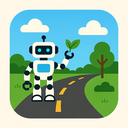
At the heart of modern technological evolution lies a compelling vision—a harmonious fusion between mechanical precision and natural vitality. The icon described here embodies this profound synthesis through three central themes: Robotics, Road, and Organic. Each element is not merely represented in isolation, but intricately interwoven to create a symbol that speaks to the future of intelligent mobility, sustainable innovation, and the evolving relationship between humanity, technology, and nature.
The central motif of this icon is a sleek, humanoid robotic figure positioned at the intersection of an abstract yet flowing road. The robot's form is modern and minimalist—its metallic torso crafted with subtle geometric lines that suggest both engineering sophistication and fluid motion. Its limbs are articulated with smooth joints, each designed to evoke agility and purposeful movement. The face features a softly glowing interface: a single, large circular lens where the eyes would be—pulsing gently in a warm blue hue that mimics the rhythm of life itself. This isn't just any machine; it’s an intelligent agent with awareness and intention, capable of perceiving its environment and adapting to change.
What makes this robot truly unique is its integration with organic textures. While the core structure remains metallic—a fusion of brushed steel and matte silver—its limbs are partially overlaid with translucent bio-organic layers. These layers resemble living tissue, with subtle vein-like patterns pulsing gently beneath a semi-transparent surface. The veins glow faintly in soft greens and golds, mimicking circulatory systems or neural pathways, suggesting that the robot is not just a product of circuits and code but also of biological inspiration. This hybridization reflects the emerging field of biohybrid robotics—machines that incorporate living cells or organic materials to enhance functionality, resilience, and environmental responsiveness.
The road in this icon is no ordinary pathway. It extends diagonally across the composition from the bottom left to the upper right, symbolizing progress, direction, and forward momentum. But it is far more than a mere line—it is alive with texture and meaning. The road surface appears as a seamless blend of polished concrete and natural terrain: compacted earth transitions into smooth asphalt in organic wave-like patterns. Embedded within its surface are glowing green nodes—tiny bioluminescent points that pulse rhythmically, resembling roots or neural synapses beneath the ground. These represent not just infrastructure but also ecosystem integration: the idea that transportation networks can be designed not to disrupt nature, but to coexist with it.
As the road curves upward toward the horizon, it begins to dissolve into a growing forest—trees with crystalline trunks made of interlocking geometric patterns merge seamlessly into their organic counterparts. This visual metaphor illustrates a future where human-made structures are no longer in opposition to nature but become part of its evolution. The robot stands at this junction—on the edge of civilization and wilderness, embodying the transition from rigid industry to intelligent symbiosis.
Further enhancing the icon’s narrative is a subtle layer of motion implied through dynamic design choices. A faint, curved trail behind the robot suggests movement—a lingering aura that captures its path forward. This trail is composed not just of mechanical dust or tire marks, but of light particles resembling seeds drifting in the air. Some land on patches of soil along the road and sprout into miniature saplings—symbolizing how technology, when guided by ecological wisdom, can foster regeneration rather than depletion.
Color plays a crucial role in communicating this message. The dominant palette balances cool metallic tones with warm earthy hues: silver and steel contrast with moss green, terracotta, and soft amber. The glowing elements—robotic eyes, bioluminescent nodes on the road, organic veins—are bathed in a spectrum of blues and greens that evoke both artificial intelligence (cool digital light) and natural vitality (biological luminescence). This chromatic balance reinforces the icon’s central theme: technology need not be cold or alienating; it can be nurturing, adaptive, and deeply connected to the living world.
Typography in the icon's surrounding space—though not part of the visual symbol itself—is designed with similar principles. When displayed alongside text, a clean sans-serif font is used, its characters subtly inspired by both machine precision and flowing organic forms. The curves in certain letters mimic plant tendrils; the sharp angles recall circuit board pathways. This typographic integration ensures that even the text complements the icon’s unified message of harmony between technology and nature.
Ultimately, this icon serves as more than a visual symbol—it is a philosophical statement about our future. It envisions a world where robotics are not detached from life but designed with ecological intelligence; where roads are not just arteries of commerce and transport but living conduits of growth and connection; and where the organic is not lost to progress, but elevated through innovation. In this vision, the robot is no longer a mechanical intruder in nature—it is a steward, an explorer, a partner in sustainable evolution.
The icon stands as a beacon: proof that humanity's most advanced technologies can emerge from the same source as our deepest natural instincts—curiosity, adaptability, and care. It invites us to imagine roads paved not just with asphalt and steel, but with possibility—and to walk them together with machines that breathe, grow, and remember.
Create your own icon with our GoGPT AI prompt:
GoGPT