

Robotics Road Simplified Free icon download
Download all to grab every PNG variant.
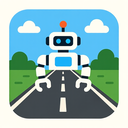
The icon presented here is a masterful fusion of technological innovation and modern design principles—representing the convergence of robotics, the vast infrastructure of transportation known as the road, and an ethos of minimalist elegance through its simplified form. Every element within this icon is intentionally crafted to convey a powerful message: that intelligent machines are not only integral to modern mobility but are doing so with clarity, efficiency, and forward-thinking design.
The central figure of the icon is a stylized robot silhouette—yet it transcends traditional depictions of humanoid automatons. Instead of intricate mechanical joints or complex circuitry patterns, this robot is distilled into its most essential components: a streamlined body with subtle geometric precision. The head is represented by a clean, rounded shape reminiscent of sensor pods or navigation systems, while the torso forms a compact parallelogram that suggests both stability and motion. Two short arms extend slightly outward from the sides—functional but not detailed—emphasizing purpose over ornamentation. Most strikingly, the robot lacks legs; instead, its base seamlessly integrates into a continuous horizontal line that represents a road beneath it.
This integration of the robotic form with the road surface is not incidental—it’s symbolic. The robot is depicted as moving forward along an undulating path that flows from left to right, suggesting progress and directionality. The path itself is rendered in a single, unbroken stroke of light blue or soft gray (depending on the design theme), giving it a smooth, continuous appearance that evokes both highways and digital data streams. This minimalistic approach to the road—no lane dividers, no signage, no vehicles—reinforces the simplified aesthetic that defines this entire icon. It is not a traffic scene; it’s a symbolic representation of autonomous movement powered by robotics.
The concept of robotics is deeply embedded in the design through both form and implied function. The robot’s body is slightly elevated, suggesting it operates above ground level—perhaps hovering just above pavement or gliding on magnetic rails—common features in modern autonomous vehicle prototypes. Its sensors (the circular shapes on its "head" and chest) are minimal but strategically placed to convey awareness of surroundings, essential for navigation systems. These elements hint at real-world robotics applications such as self-driving cars, delivery drones, or intelligent road maintenance units—machines that perceive their environment and respond accordingly with precision.
Yet the icon avoids technical clutter. There are no wires, gears, or circuit patterns—elements often associated with robotics in more complex illustrations. Instead, the design embraces simplified visual language: flat colors, geometric shapes, negative space as an active design element. The entire composition is contained within a square or circular frame (depending on application), making it instantly recognizable even at small sizes—ideal for use in app interfaces, websites, or digital dashboards. This simplicity isn't a compromise; it's a deliberate strategy to communicate complex ideas quickly and universally.
Furthermore, the icon’s color palette reinforces its message. A primary shade of deep blue or electric teal may be used to represent technology and innovation, while white or light gray provides balance and clarity. The road is rendered in a slightly lighter tone to create visual separation without distraction. This restrained use of color aligns perfectly with modern design trends that prioritize legibility, accessibility, and emotional neutrality—hallmarks of the simplified aesthetic.
In terms of scalability, the icon performs exceptionally well. Whether displayed on a smartphone screen or a large digital billboard, every line remains crisp and meaningful. The absence of fine details ensures that it does not lose definition when resized—a crucial attribute for icons used across multiple platforms and devices. This universality makes it ideal for use in contexts related to smart cities, autonomous transportation systems, robotics startups, or educational tools teaching the basics of AI and mobility.
Ultimately, this icon transcends mere representation—it encapsulates a vision. It speaks to a future where robots are not isolated machines confined to factories or labs but are embedded into the very fabric of urban life—moving along roads with intelligence, grace, and purpose. Through its robotics-centric form, its symbolic connection to the road, and its commitment to a clean, uncluttered simplified style, this icon becomes a powerful visual metaphor for progress: efficient, integrated, and accessible.
In summary, the icon is more than just an image—it’s a narrative in minimal form. It tells the story of technology that moves forward not through complexity but through clarity. Every line serves a purpose; every shape communicates meaning. In an age overwhelmed with visual noise, this icon stands out precisely because it says so much with so little—proving that innovation and simplicity are not opposites, but partners in progress.
Create your own icon with our GoGPT AI prompt:
GoGPT