

Robotics Satellite Playful Free icon download
Download all to grab every PNG variant.
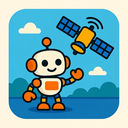
Imagine a vibrant digital icon that encapsulates the dynamic synergy between advanced robotics and interplanetary exploration—yet does so with an unmistakably whimsical, playful spirit. This is not merely a symbol of technological progress; it's a celebration of imagination, innovation, and joy in engineering. The icon presents a cheerful, humanoid robot with satellite-like features, seamlessly blending futuristic design with childlike wonder.
The central figure is a small but expressive robot—about the size of an adult’s palm—crafted with smooth, rounded edges that evoke warmth and approachability. Its body is composed of soft metallic hues: brushed silver and sky-blue accents, reminiscent of polished aerospace components. However, instead of cold or rigid lines, the robot features flowing curves and gentle contours, suggesting movement and curiosity rather than mechanical sterility. The head is large relative to its body—a classic design choice in playful robotics—complete with two oversized eyes that sparkle with digital light: one blue like a clear sky and the other green like a lush forest. These eyes are animated by subtle blinking effects, giving the robot an alert, friendly demeanor.
What transforms this robot from simply cute into something extraordinary is its integration of satellite elements. The robot’s back is crowned with a compact, stylized satellite dish—a circular ring with delicate radial arms that extend outward like a blooming flower. This "satellite crown" isn’t just decorative; it's functional in design, suggesting connectivity and communication across vast distances. The dish glows faintly with a soft white light that pulses gently, mimicking the rhythm of data transmission. Embedded within the ring are tiny LED-like dots that mimic star patterns—representing its ability to navigate through space or receive signals from deep orbit.
Instead of traditional arms, the robot has two articulated limbs that resemble robotic tentacles made from flexible, segmented tubing. These limbs bend and twist with a springy animation when the icon is interactive, as if reaching out to explore or send a signal. At the end of each limb is a small sensor pod—shaped like an orb with three reflective lenses—that glows softly in different colors depending on its mode: blue for data reception, yellow for energy collection, and pink for playful interaction.
The robot’s feet are not standard treads or wheels but tiny thrusters shaped like cartoonish rocket boots. Each boot emits a gentle puff of steam or light particles when animated—adding a whimsical touch that suggests the robot is capable of floating in zero gravity or hopping between celestial bodies with delight. The entire figure appears to float slightly above the ground, giving it an otherworldly, weightless presence.
Surrounding the robot are three miniature satellite orbs orbiting in a slow spiral—each one glowing with its own color: red for communication, green for environmental scanning, and gold for energy harvesting. These satellites don’t just float around passively; they perform small dance-like movements, bobbing up and down as if dancing in harmony with the robot. The orbit is circular but slightly wobbly—an intentional imperfection that reinforces the playful aesthetic.
The background of the icon is a minimalist space scene—deep navy blue with scattered stars that twinkle softly. But even here, playfulness breaks through: some stars are shaped like smiley faces or tiny rockets; one constellation forms the outline of a grinning face, while another looks like an open book—symbolizing curiosity and learning. This subtle detail reinforces the idea that space exploration isn’t just serious science—it’s also a grand adventure full of wonder.
The entire icon operates under a light animation loop: the robot blinks, its satellite crown pulses, the orbiting satellites swirl gently, and the thrusters emit tiny sparkles. Yet everything moves with a slow, soothing rhythm—never overwhelming or frantic—inviting users to pause and appreciate its charm.
Visually speaking, this icon speaks to multiple audiences. To engineers and space enthusiasts, it represents cutting-edge robotics with satellite capabilities: autonomous exploration, long-range communication, and deep-space navigation. To children and casual users, it’s a friendly character that sparks imagination—like a robot astronaut from a storybook or an animated companion on an interstellar journey. The blend of high-tech elements with cartoonish design creates an accessible bridge between complex science and joyful expression.
The emotional tone is key: this icon doesn’t just convey information—it evokes feeling. It embodies the belief that technology, especially in fields like robotics and space exploration, can be both powerful and fun. It encourages curiosity, promotes STEM learning through delight, and reminds us that progress doesn’t have to feel cold or distant.
In conclusion, this icon masterfully integrates the three keywords—Robotics (through its humanoid form and advanced features), Satellite (via the orbiting units and satellite crown), and Playful (through animation, colors, shapes, and whimsical design elements)—into a single cohesive image. It stands as a modern emblem of innovation that wears its heart on its circuit board: intelligent yet joyful, futuristic yet warm.
Create your own icon with our GoGPT AI prompt:
GoGPT