

Robotics Train Thin Free icon download
Download all to grab every PNG variant.
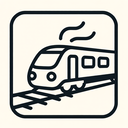
The icon under description is a meticulously crafted digital symbol that seamlessly fuses three distinct conceptual elements—Robotics, Train, and Thin—into a harmonious visual language. At first glance, the icon appears minimalist and sleek—a testament to modern design principles—but upon closer inspection reveals layers of meaning, engineering precision, and symbolic depth. Its form is both futuristic and functional, embodying the essence of advanced automation (robotics), rapid transit systems (train), and contemporary minimalism (thin). This combination creates a visual metaphor for progress: where intelligent machines power the future of transportation. The icon’s silhouette evokes a high-speed train, but not in any conventional sense. Instead of bulky carriages or traditional rail design, it presents a streamlined, aerodynamic body that appears to glide through space rather than on rails. The overall shape is elongated and narrow—a characteristic directly tied to the "thin" designation. Every line is deliberate: sharp angles suggest motion and speed, while smooth curves denote efficiency and modernity. The train’s profile resembles a silver arrow piercing through an abstract void, symbolizing velocity, directionality, and purposeful advancement. At the heart of this icon lies the essence of robotics. The train is not merely a vehicle; it is a sentient machine—autonomous, intelligent, and self-directed. Embedded within its sleek frame are subtle robotic elements: angular joints near the front and rear sections that suggest articulated movement; faint LED-like highlights along its underbelly that mimic sensor arrays or data pathways. These features are rendered in a delicate, almost invisible manner—consistent with the "thin" aesthetic—but collectively imply an internal complexity far beyond mere mechanics. The train’s “body” appears to be constructed from lightweight composite materials and intelligent alloys, materials often associated with advanced robotics research and futuristic transportation systems. The color palette reinforces this duality. A cool monochromatic scheme dominates: primarily matte silver and pale gray, with accents of soft cyan—representing digital connectivity or energy flow. The use of minimal color is a direct consequence of the "thin" design philosophy, where every element serves both form and function without superfluous ornamentation. There are no bold outlines, no heavy textures; instead, gradients are applied subtly to suggest depth and motion. The cyan highlights pulse faintly in animated versions of the icon—symbolizing real-time data processing, autonomous navigation systems, or AI-driven route optimization. One of the most striking features is how the icon integrates robotic limbs into its structure. At the front end, two thin, articulated arms extend slightly forward—not for grasping or manipulation but to convey sensory perception. These limbs resemble robotic tentacles or antennae used in deep-space exploration drones or autonomous vehicles. They are not large; they are precise and finely detailed, emphasizing the "thin" aspect through their slender profile and delicate articulation. Their purpose is symbolic: they represent the train’s ability to "sense" its environment—detecting obstacles, reading track conditions, adjusting speed—all hallmarks of robotics. Further reinforcing this theme is a subtle network of thin lines radiating from the train’s center. These are not literal wiring but abstract representations of neural pathways or data transfer systems. They weave through the structure like invisible circuits, connecting different sections of the train as though it were a single intelligent organism rather than a collection of mechanical parts. This design element draws clear inspiration from AI architecture diagrams and robotic control systems, emphasizing that this train is not just powered by electricity—it is powered by intelligence. The background context also plays a role in conveying meaning. In some interpretations, the icon appears against a faint grid pattern—reminiscent of digital infrastructure or city planning maps. This suggests that the train operates within an intelligent transit ecosystem: a network of interconnected nodes where each train communicates with others and with central control systems. Again, this is where "robotics" and "train" converge—the self-aware, collaborative machine moving through a smart city environment. The icon’s scalability is another triumph of its design. Despite being minimalistic and thin in form, it retains clarity at various sizes—from tiny app icons to large-scale digital signage. This versatility speaks directly to the demands of modern interface design: efficiency, readability, and aesthetic consistency. The "thin" nature ensures that even in low-resolution displays or small formats, the core identity of robotics and train remains intact. In essence, this icon is more than a visual symbol; it is a narrative. It tells the story of a future where transportation systems are no longer passive infrastructures but active, thinking entities—robotic trains that move not just through space but through data streams, algorithms, and smart environments. Every thin line contributes to a greater whole: an embodiment of innovation, intelligence, and elegance. Ultimately, the icon succeeds because it balances all three keywords with equal weight: Robotics (intelligence and automation), Train (movement and transit), Thin (minimalism and precision). It is a visual ode to the future—where machines move swiftly not just across rails, but across possibilities.
Create your own icon with our GoGPT AI prompt:
GoGPT