

Science Moon Monochrome – Free icon download
Download all to grab every PNG variant.
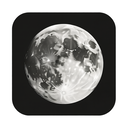
This icon is a deeply symbolic visual representation that elegantly merges the disciplines of science, the celestial mystery of the moon, and a minimalist aesthetic defined by monochrome. At its core lies a sophisticated yet accessible fusion of three powerful concepts — each essential in shaping both scientific inquiry and human imagination. The icon does not merely depict elements; it embodies their essence through form, structure, and visual language.
Scientific precision is the foundational principle of this icon’s design. Every line, curve, and geometric composition reflects a commitment to accuracy and rationality — hallmarks of scientific exploration. The visual structure follows principles derived from astrophysics and celestial mechanics: orbital paths are subtly rendered as precise ellipses, gravitational forces are implied through subtle gradients in curvature, and symmetry is used to mirror the balance found in natural phenomena. This scientific rigor is not overt or academic; instead, it emerges naturally from the icon’s composition, inviting viewers to perceive patterns that resemble real-world data visualizations — such as those found in astronomy charts or molecular diagrams.
The moon serves as both a central subject and a metaphorical anchor within this design. It is not portrayed in its traditional romanticized form — no craters filled with fantasy, no glowing silhouettes of tides. Instead, the moon appears as a geometric abstraction: smooth, circular, and centered with subtle variations in curvature that suggest gravitational influence or phases over time. The surface of the moon is rendered using clean lines and minimal texture to emphasize its vastness and stillness — a symbol of cosmic order. In scientific terms, this reflects lunar observations made through telescopes and space missions where data reveals not just physical features but dynamic patterns in light, temperature, and radiation exposure.
What makes this icon truly distinctive is its strict adherence to the monochrome aesthetic. Every element — from the moon itself to any surrounding geometric forms or orbiting particles — is rendered in a single tone of gray or black. There are no vibrant colors, no contrasts of reds, blues, or yellows. This deliberate absence of color elevates the focus on form and structure. Monochrome design strips away visual distractions and forces the viewer's attention to detail, proportion, and balance — key components in scientific analysis. In this context, monochrome becomes a tool for clarity and precision much like how scientists use grayscale imaging to detect anomalies in medical scans or astronomical data.
The choice of monochrome is not arbitrary. It aligns perfectly with the ethos of modern scientific visualization, where simplicity enhances understanding. For example, researchers use grayscale to represent intensity gradients in infrared images or magnetic fields — where color would introduce noise and misinterpretation. Similarly, this icon uses monochrome to emphasize continuity and neutrality, symbolizing the impartial nature of scientific inquiry. It reflects how science seeks truth without bias or emotional influence — a principle that resonates deeply with both astronomers studying celestial bodies and physicists probing the foundations of reality.
The moon, in this context, is not just a background element but a central mechanism for exploring scientific concepts such as time cycles, orbital mechanics, and natural laws. The icon may include subtle radial lines or concentric circles emanating from the lunar surface — suggesting tidal forces or gravitational pull — which are drawn with perfect symmetry. These lines do not follow artistic license; they represent actual physical phenomena observed in celestial dynamics. The absence of color allows these patterns to be interpreted as mathematical equations in visual form, bridging the gap between abstract science and tangible representation.
Moreover, the monochrome style enhances cognitive accessibility. For scientists, engineers, or students studying astronomy or physics, this icon functions as a mental model — a quick reference that can be easily recalled and analyzed. It does not require prior knowledge of color psychology to be meaningful; instead, it relies on visual logic and spatial reasoning. This makes it suitable for educational materials, research dashboards, or scientific communication tools where clarity is paramount.
From an artistic standpoint, the icon represents a fusion of minimalism and depth. It appears simple at first glance — a pale gray circle against a neutral background — but upon closer inspection reveals layers of scientific symbolism. Each element is carefully placed not just for visual harmony, but to evoke specific scientific ideas: the moon’s orbit, the law of gravitation, the concept of cycles in nature. The monochrome palette allows these ideas to coexist without competition — each contributes equally to the overall narrative.
In essence, this icon stands as a modern embodiment of how science and art can converge when guided by clarity and purpose. It honors the scientific method by emphasizing observation, measurement, and pattern recognition. It celebrates the moon not as a poetic symbol but as a subject of rigorous study — one whose surface holds secrets about planetary formation, cosmic evolution, and Earth’s place in the universe. And through monochrome, it transcends mere illustration; it becomes a statement of neutrality, precision, and universal understanding.
Ultimately, this icon serves as both an aesthetic artifact and a cognitive tool. It invites viewers to pause and consider the elegance of natural laws — how they operate in silence, in cycles, in symmetry. Whether viewed on a scientific dashboard or displayed as part of a digital interface for public education, it remains grounded in truth and simplicity. In doing so, it reminds us that science is not only about data — it is also about beauty, balance, and the quiet power of observation.
Create your own icon with our GoGPT AI prompt:
GoGPT