

Science Robot Line art – Free icon download
Download all to grab every PNG variant.
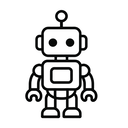
At the intersection of imagination, technology, and human curiosity lies a powerful visual symbol: the "Science, Robot, Line Art" icon. This minimalist yet evocative illustration is more than just a graphic—it is a concise representation of modern innovation, intellectual exploration, and technological progress. Designed with precision and intentionality, this icon masterfully synthesizes three distinct but interconnected elements: Science, Robot, and Line Art. Each component plays a crucial role in shaping the overall meaning, aesthetic appeal, and functional relevance of the icon across digital platforms.
Firstly, the element of Science is deeply embedded throughout this icon’s design. Science is not merely an abstract concept; it is a dynamic force that drives discovery, experimentation, and understanding of the natural world. In this icon, science manifests through form and structure—geometric shapes such as circles, triangles, spirals, and intersecting lines suggest laboratory environments, molecular structures, or data pathways. These forms are not random; they evoke scientific principles like atomic composition or wave patterns. The inclusion of subtle gradients in line weight or directional flow mimics the movement of particles in a physical experiment or the progression of scientific inquiry over time. This reflects how science is both a field of study and a process—continuous, methodical, and driven by observation and analysis.
Secondly, the Robot component serves as both the central figure and symbolic agent within this icon. A robot here does not refer to a simplistic mechanical arm or factory worker; instead, it represents intelligence, automation, adaptability, and future-oriented thinking. The robot is rendered in a stylized form—sleek, clean lines with minimal features such as a circular head, segmented body segments resembling joints or circuits, and possibly subtle elements like glowing eyes or a central processor module. These design choices emphasize functionality and efficiency while avoiding the overly bulky or industrial look often associated with outdated robotics depictions. The robot in this icon embodies the fusion of human ingenuity with mechanical precision—a hallmark of modern scientific advancement.
Crucially, this robot is not drawn as a 3D model or a realistic figure; it is rendered in Line Art. Line art—defined by its use of simple, continuous lines without color fills or textures—is a powerful stylistic choice that enhances clarity, scalability, and universality. The absence of color allows the icon to be used across various digital mediums—from mobile apps and websites to scientific documentation and educational tools—without compromising legibility or performance. Line art also emphasizes form over detail, which is especially important in a design that aims to convey broad conceptual ideas like science or technology rather than specific physical objects.
From a visual standpoint, the line art style gives this icon an elegant, almost architectural quality. The robot’s limbs may extend diagonally or in smooth arcs, suggesting motion and potential energy. The lines converge at the center to form a focal point that symbolizes the integration of science into robotic systems—where data processing, sensors, and machine learning converge to produce intelligent behavior. This central convergence also mirrors scientific experiments where multiple variables are tested simultaneously to yield results. The use of clean, unbroken lines reinforces a sense of logic and order—core tenets of scientific methodology.
Functionally, the icon is designed for broad accessibility. Whether displayed in a research institution’s digital portal, an educational app about STEM fields, or a software dashboard tracking data analytics, this icon immediately communicates its theme without requiring explanation. Its simplicity ensures that users from diverse backgrounds—children learning about science, engineers reviewing system interfaces, or policymakers evaluating technological progress—can interpret it instantly. This cross-cultural and age-appropriate clarity is a direct result of the line art style’s universal appeal.
The scientific accuracy of this icon is not compromised by its artistic stylization. On the contrary, its abstraction enhances understanding by removing visual clutter and focusing attention on core concepts. For instance, a robot with circuit-like lines flowing through its body can symbolize data flow or neural networks—a key element in artificial intelligence and computational science. Similarly, the circular shape of the head might suggest a central processing unit (CPU), while intersecting lines could represent variables, equations, or experimental parameters.
Moreover, this icon functions as a visual metaphor for interdisciplinary collaboration. Science and robotics are not separate domains; they interact constantly in fields such as biotechnology, space exploration, medicine (robotic surgery), and environmental monitoring. By merging these two elements into one cohesive symbol through line art, the icon encourages users to see technology not as a standalone tool but as an extension of scientific inquiry. It promotes a mindset where innovation arises from curiosity and observation—both foundational to science.
In educational contexts, this icon can serve as a teaching aid. Teachers may use it in classrooms to introduce students to concepts like automation, data collection, or engineering principles. Students can analyze the lines and shapes to deduce what elements represent—developing critical thinking skills while engaging with visual learning tools. The line art style also allows for easy modification or adaptation: teachers could add labels, change line thicknesses, or introduce color overlays in digital versions to expand learning outcomes.
Finally, this icon is scalable and adaptable. Because it relies on vector-based line art (a common standard in graphic design), it can be resized without losing quality—essential for use across different screen resolutions and print formats. Whether displayed on a tablet, smartwatch, or scientific poster, the icon maintains its integrity and meaning. This adaptability makes it ideal for branding initiatives related to science education, research institutions, or tech innovation hubs.
In conclusion, the "Science, Robot, Line Art" icon is not just a graphic—it is a narrative of progress and human potential. It combines the rigor of scientific thought with the promise of technological advancement through a minimalist yet deeply symbolic form. The use of line art ensures clarity and universality while allowing each component—science, robot, and line work—to stand out in harmony. This icon stands as a testament to how visual design can communicate complex ideas simply, effectively, and powerfully.
Create your own icon with our GoGPT AI prompt:
GoGPT