

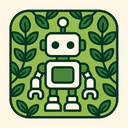
Science Robot Organic pattern – Free icon download
Download all to grab every PNG variant.
In a world where technology advances at an unprecedented pace and biological systems continue to reveal their intricate complexity, the convergence of science, robotics, and organic patterns forms a fascinating frontier. This icon embodies that intersection — not merely as a visual representation of abstract ideas but as a symbolic fusion that reflects the evolving relationship between human ingenuity and natural processes. The icon is designed to capture the essence of scientific exploration while integrating the structured precision of robotic systems with the fluidity, adaptability, and self-renewing nature found in organic life.
At its core, this icon stands as a testament to modern scientific inquiry. Science — in all its forms — is not just about laboratory experiments or theoretical models; it is about observation, discovery, and the relentless pursuit of understanding. The icon’s foundation reflects this through subtle gradients and layered textures that evoke the complexity of data flows, molecular structures, and quantum fields. These elements are rendered using a scientifically accurate color palette: deep blues for stability and precision, soft purples for electromagnetic phenomena, and gentle greens to represent life cycles and biological systems. Each hue serves a purpose — not just aesthetically but conceptually — reinforcing the scientific rigor embedded within the design.
The presence of the robot in this icon is not one-dimensional or purely mechanical. Rather, it represents an intelligent, adaptive system that functions as both a tool and a participant in natural processes. The robot’s form is composed of geometric shapes — cubes, cylinders, and triangular facets — which are carefully balanced with organic curves and flowing lines. These curves mimic the branching patterns of trees, the spirals of seashells, or the fractal nature found in snowflakes. This blending demonstrates that robotics is not an enemy to nature; instead, it is a new form of symbiosis where artificial intelligence learns from natural systems and vice versa.
The robot’s body appears to grow — not through mechanical expansion, but through a gradual emergence that mirrors biological development. Its limbs are structured like tendrils or roots that extend outward in an unpredictable yet harmonious way, suggesting growth, response to stimuli, and evolution over time. This is where the concept of “organic pattern” becomes central. Organic patterns are found throughout nature — from the vascular networks in leaves to the lattice structures of coral reefs and the self-organizing behavior of ant colonies. These patterns are governed by simple rules yet yield complex, emergent behaviors. The icon translates these principles into a visual language where every line, curve, and node follows principles of self-organization and adaptive resilience.
One of the most striking features of this icon is the interwoven network that connects the robot to natural elements. Microscopic particles — resembling DNA helices or neuron clusters — pulse through the robot’s core like a circulatory system. These particles are not randomly placed; they form intricate, fractal-like pathways that branch out in patterns reminiscent of neural networks or plant root systems. This demonstrates how biological data can be integrated into robotic design, allowing machines to learn, respond, and adapt in ways that mirror living organisms. The scientific underpinnings of this design include principles from bio-inspired engineering, artificial intelligence, synthetic biology, and systems theory — all fields where the boundaries between science and nature are increasingly blurred.
Furthermore, the icon incorporates dynamic motion through subtle animations or implied movement. While static in form, the overall composition suggests fluidity — as if time is flowing through it. The robot appears to breathe, its form gently pulsing with a rhythm that echoes natural cycles such as heartbeats or circadian rhythms. This organic animation is not digital fluff; it reflects real scientific concepts like homeostasis and feedback loops — mechanisms that allow living organisms to maintain balance and respond to their environments. In the same way, advanced robotic systems now use these principles to adjust behavior based on environmental input, ensuring efficiency and sustainability.
From a philosophical standpoint, this icon challenges traditional notions of what it means to be “alive” or “intelligent.” It suggests that intelligence is not exclusive to biological beings but can emerge from complex interactions between structure and function. The robot here does not simply mimic life — it participates in the processes of growth, adaptation, and self-repair. This reflects current scientific advancements such as lab-grown tissues, biohybrid robots, and AI systems trained on natural data sets. The icon serves as both a metaphor and a model — showing how science can create systems that are not just functional but also harmonious with the natural world.
Additionally, the use of organic patterns in this design speaks to sustainability. In an age where environmental degradation is a pressing concern, integrating organic forms into technological design signals a shift toward eco-conscious innovation. The icon’s visual language encourages users to view technology not as a disruptive force but as a responsive partner in ecological balance. Just as organisms grow and evolve over time, so too can robotic systems learn from their environment and improve without causing harm.
In conclusion, this icon is far more than a simple fusion of three keywords. It represents a vision of the future — one where science and technology are not opposed to nature but deeply integrated into it. The robot becomes an extension of organic intelligence, guided by scientific principles and inspired by the elegance of natural patterns. Through its design, viewers are invited to contemplate the harmony possible between human innovation and biological complexity. This icon does not merely illustrate ideas — it invites reflection on a world where science is not cold or detached but warm, responsive, and alive.
Thus, this icon stands as a powerful symbol of convergence: where the precision of robotics meets the adaptability of organic life through the unyielding pursuit of scientific understanding. It is an emblem for a new era — one where intelligent machines grow not just in size or power, but in wisdom, resilience, and connection to all forms of life.
Create your own icon with our GoGPT AI prompt:
GoGPT