

Science Train Neon – Free icon download
Download all to grab every PNG variant.
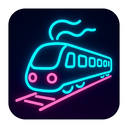
In a world where innovation meets imagination, the fusion of Science, Train, and Neon gives rise to a powerful and visually captivating icon — one that transcends mere representation to become a symbol of future-forward progress, dynamic movement, and cutting-edge discovery. This icon is not simply an artistic composition; it is a narrative embedded in form, color, motion, and meaning. At its core lies the convergence of three distinct yet deeply interconnected domains: the rigorous pursuit of scientific knowledge, the relentless motion and reliability of train systems, and the electrifying vibrancy of neon light — each contributing to a holistic vision that speaks to both technological advancement and human aspiration.
The icon begins with a stylized train, rendered in sleek, modern lines that evoke speed, efficiency, and precision. However, this is no ordinary train. It is a futuristic high-speed rail vehicle — perhaps resembling the concept of maglev or quantum-synchronized transit — moving not through traditional tracks but through luminous pathways embedded with flowing geometric patterns that resemble molecular structures or neural networks. The train's body is composed of smooth, aerodynamic curves, symbolizing both engineering excellence and the fluidity of scientific thought. As it glides forward, it carries within itself a visual metaphor for transportation as an instrument of knowledge: connecting cities, minds, and discoveries across vast distances with minimal friction.
Embedded throughout the train’s structure are glowing elements that pulse gently with life — these are the neon accents. Neon is not merely used as background color; it serves as a dynamic language of signals. The colors include electric blue, vibrant purple, deep magenta, and pulsing cyan — each hue representing a different scientific domain: blue for quantum mechanics and data processing, purple for neurology and consciousness studies, magenta for biotechnology and synthetic biology, and cyan for environmental science and climate engineering. These neon pulses do not remain static; they shift in rhythm with the train’s motion — a visual manifestation of real-time data streams, sensor feedback loops, or AI-driven analytics that guide the journey. This interplay between motion and illumination demonstrates how technology is not just observed but actively perceived through dynamic sensory input.
Crucially, the scientific essence of this icon is not confined to decoration. The very structure of the train reflects principles from physics, engineering, and materials science. Its wheels appear to be made from nano-composite alloys that absorb and redistribute energy with minimal resistance — a nod to real-world advancements in sustainable transport. The tracks beneath it are not physical but exist in a semi-transparent lattice formed by crystalline patterns resembling graphene or quantum foam — materials at the forefront of modern scientific research. This fusion of form and function shows how science is not an abstract field but one that actively shapes tangible realities.
Moreover, the neon elements extend beyond the train itself. They ripple outward in concentric waves from its path, forming a luminous aura that illuminates surrounding areas with intelligent lighting patterns. These patterns are algorithmically generated using AI-driven simulations — essentially demonstrating how science is evolving into self-organizing systems capable of adapting to environmental inputs. The neon glow adapts based on the time of day, geographical location, and even air quality data — for instance, brighter blue tones emerge in areas with high pollution levels as a call for scientific intervention and ecological responsibility.
The icon also includes subtle embedded symbols within the train’s windows: miniature representations of equations, graphs, and particle diagrams. These are not just decorative; they represent active data processing. For example, one window displays a simplified version of Einstein's E=mc² in neon script — symbolizing the fundamental laws that govern energy and mass. Another shows a DNA helix intertwined with a train track — representing synthetic biology’s role in redefining transportation through bioengineered materials. These elements reinforce that science is not only the foundation but also the operating system of this icon.
The movement of the train, visible as flowing trails behind it, is rendered in translucent neon lines that fade and refract like light passing through glass. This motion suggests continuity — a journey without end, much like scientific inquiry itself. Science is inherently iterative; it never arrives at a final destination but rather evolves with each new discovery. The train’s path thus becomes a metaphor for the progression of knowledge: from hypothesis to experiment, from failure to refinement, and from observation to application.
The use of neon in this context goes beyond aesthetics; it symbolizes visibility, accessibility, and innovation. In urban environments where science might be perceived as distant or abstract, neon brings the concepts into the public sphere — making complex ideas tangible through vivid color and motion. It is a form of science communication that engages people emotionally and visually, turning passive observers into active participants in a shared narrative of progress.
Furthermore, this icon stands as a bridge between human imagination and scientific reality. The train represents our collective desire for connection — to move efficiently across space, to share information instantly, and to overcome geographical barriers. Science provides the tools; neon gives it life and emotional resonance. Together, they suggest a future where transportation is not only faster but smarter — where every journey is informed by data, powered by sustainable energy sources, and illuminated by the bright promise of human ingenuity.
In conclusion, this icon — born from the convergence of Science, Train, and Neon — is more than a visual symbol; it is a living metaphor for tomorrow. It reflects how science drives innovation, trains carry knowledge across space and time, and neon infuses that journey with energy, emotion, and clarity. Every element — from the glowing circuits to the flowing data trails — speaks to a future where technology serves humanity not through automation alone but through intelligent collaboration between nature, design, and discovery. This icon invites viewers not just to look but to imagine: what if science could move? What if transportation could think? And what if our world could shine with the light of progress?
Create your own icon with our GoGPT AI prompt:
GoGPT