

Software Bus Cyberpunk Free icon download
Download all to grab every PNG variant.
```html
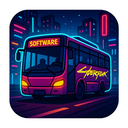
At the heart of a dystopian digital metropolis, where data streams pulse through glowing arteries and artificial intelligence thrums in the shadows, lies an icon that encapsulates the essence of modern technological convergence: the Cyberpunk Software Bus. This intricately designed symbol is not merely an image—it's a narrative, a visual manifesto of how software transcends its digital realm to become a living, breathing entity that operates within and shapes the urban landscape. By fusing three critical elements—Software, Bus, and Cyberpunk—the icon presents an audacious fusion of functionality, movement, and futuristic aesthetic.
The central form of the icon is a stylized urban transit vehicle—a retro-futuristic bus that has evolved beyond its conventional purpose. Its frame is forged from sleek, matte black alloy with iridescent blue and electric violet circuit patterns etched into its surface like tattoos of digital code. The body is elongated and aerodynamic, reminiscent of a high-speed maglev train but with the unmistakable silhouette of a city bus—its windows replaced by transparent OLED displays that flicker with real-time data streams. Each window reveals scrolling lines of binary code, live traffic maps in augmented reality overlays, and fragments of encrypted messages that pulse like neon veins.
The bus’s wheels are not metal or rubber but shimmering rings of pure energy—hovering above the ground by repulsor fields, leaving faint afterimages as they rotate. Its front end features a massive, forward-facing sensor array composed of concentric rings emitting low-frequency pulses, scanning for anomalies in the networked environment. The roof is crowned with a rotating holographic antenna shaped like a digital crown—symbolizing sovereignty over information flow and dominance in the data ecosystem.
What elevates this bus from mere vehicle to revolutionary symbol is its integration of Software. The entire structure is not built—it is compiled. Every bolt, wire, and panel functions as a node in a self-updating neural network. The software isn't hidden; it’s displayed in real-time across the bus’s surface through translucent, animated layers of code that shift and reconfigure like living organisms.
The icon features a transparent "core" at the center of the bus—a rotating sphere composed entirely of fluid-like lines of hexadecimal code, Python syntax, and custom AI algorithms. This core is not static; it responds to external stimuli—changing form when data traffic spikes or when a new software patch is downloaded. Glowing green nodes within this sphere pulse rhythmically like heartbeats, indicating the health and activity of the onboard operating system.
Additionally, digital avatars—semi-transparent humanoid figures composed entirely of animated code—are seen "riding" inside the bus through augmented reality windows. These represent autonomous software agents: one is a security firewall in red armor with shield symbols; another is an AI data broker in silver chrome, trading encrypted files between nodes. The entire bus functions as a mobile operating environment—an on-the-go server that processes, routes, and protects data across the city’s digital infrastructure.
The Cyberpunk aesthetic is not just an artistic choice—it's the soul of this icon. It embodies the genre's core themes: high-tech, low-life; corporate dominance intertwined with grassroots resistance; artificial intelligence that mirrors human consciousness yet remains detached. The bus is bathed in a perpetual twilight of neon—a fusion of crimson reds, electric blues, and radioactive greens—cast by towering holographic advertisements floating above crumbling skyscrapers. Rain streaks down the windows in slow motion, each droplet refracting light into prismatic patterns that distort the view.
Scratched surfaces reveal layers beneath: ancient mechanical components juxtaposed with sleek nanotech interfaces. The bus isn't pristine; it bears scars of battles fought—not in war zones but in firewall breaches and data wars. A small red "virus" symbol glows faintly on one panel—a reminder that even the most advanced software is vulnerable.
Yet, within this decay lies beauty. The contrast between the cold, impersonal technology and the warmth of human expression (seen in fleeting digital graffiti tags like “REBELCODE” or “FREEDOM_01”) reflects cyberpunk’s duality: a world where humanity struggles to remain relevant amidst its own creations.
The Cyberpunk Software Bus icon is far more than a graphic element—it’s a metaphor for the future of digital infrastructure. It represents how software has evolved from static programs into dynamic, mobile ecosystems that travel through cities like sentient entities. The bus is both transportation and server, physical object and digital construct. In this vision, technology doesn’t serve us; it becomes part of our urban life—rarely seen but always present, constantly updating, adapting.
With its fusion of Software, Bus, and Cyberpunk aesthetics, the icon captures the tension between control and freedom, order and chaos. It is a symbol of resilience in an age where data is power—and power must be carried through the streets in a glowing, code-crawling machine that never stops.
This icon doesn't just represent technology—it envisions it. And in doing so, it redefines what a bus can be: not just something that takes us places—but something that carries our digital future forward, one encrypted byte at a time.
```Create your own icon with our GoGPT AI prompt:
GoGPT