

Software Bus Pixel art Free icon download
Download all to grab every PNG variant.
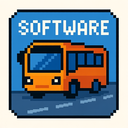
The icon in question is a masterful fusion of three distinct yet interconnected concepts: Software, Bus, and Pixel Art. It encapsulates the essence of modern digital innovation while paying homage to the nostalgic charm of early video game aesthetics. This meticulously crafted pixel art piece stands as a symbolic bridge between abstract code and tangible transport—where software doesn’t just run on machines but literally travels through digital highways in the form of a retro-styled bus.
At first glance, the icon presents a vibrant 16x16-pixel grid, a standard size for classic pixel art. Each pixel is intentionally placed with purpose, adhering to strict rules of limited color palettes and precise line work. The background is rendered in a soft gradient of deep navy blue (#0F0F23), evoking the night sky or an empty digital realm, while the main subject—a stylized bus—jumps out in contrast with electric cyan (#00FFFF) and bright yellow (#FFD700). These colors are not arbitrary; they reflect a deliberate design choice to represent digital data flow (cyan) and energy transmission (yellow), both central themes in software infrastructure.
The bus itself is rendered using clean, blocky geometry typical of 8-bit video game design. It features a rectangular body with rounded edges at the corners—reminiscent of early handheld consoles like the Game Boy or Nintendo DS. The front half of the vehicle is dominated by a large, pixelated windshield made from alternating black and white squares to simulate glass reflection under artificial light. Two headlights, each formed from three vertical pixels (bright yellow on black), glow forward with a steady rhythm, suggesting motion and constant connectivity.
On the roof of the bus, a glowing antenna rises in four distinct segments—each pixel carefully positioned to form an upward-pointing arc. This antenna is not merely decorative; it symbolizes data transmission, acting as a digital aerial for software signals. The connection between the physical bus and its digital function becomes clear here: this is no ordinary vehicle—it carries data packets, updates, applications, and firmware across virtual networks.
The sides of the bus are emblazoned with pixelated text in a retro monospace font (similar to ASCII art): "SOFTWARE TRAM 3.0". This line subtly reinforces the icon’s dual identity—both a transport mechanism and a software delivery system. The digits "3.0" are highlighted in green (#00FF00), suggesting versioning, progression, and technological advancement, while the word "TRAM" hints at urban transit systems used in real-world software deployment models (e.g., continuous integration pipelines).
Inside the bus’s windows (represented by four 2x3 pixel rectangles), tiny figures—stylized as glowing blue pixels—can be seen moving back and forth. These are not random; they symbolize software processes, threads, or data streams flowing within a running application. Each figure is unique in shape and direction, suggesting dynamic activity and parallel processing—a nod to modern multi-threaded programming environments.
The wheels of the bus are circular but constructed from 12 pixels each (in a ring formation), giving them an authentic retro feel. They rotate in a loop animation when displayed in motion, with one pixel changing color per frame to simulate turning—this subtle effect enhances realism within the constraints of pixel art. The tire treads are visible as grooves formed by alternating black and gray pixels, reinforcing the idea of movement across digital terrain.
What truly sets this icon apart is its conceptual depth. While it appears whimsical at first, it conveys a powerful metaphor: software does not exist in isolation—it travels. Like buses moving along designated routes, applications and updates are deployed through structured pathways—networks, servers, cloud platforms—each acting as a digital transit system. The pixelated aesthetic adds emotional resonance: users who grew up with classic games instantly recognize the nostalgic value of this design, while developers appreciate the technical precision required to render complex ideas in such minimal space.
From a technical perspective, every element adheres strictly to pixel art principles. No anti-aliasing is used; all shapes are hard-edged and aligned to a grid. Transparency is simulated using dithering patterns—small alternating pixels of color that create the illusion of depth or fade. This level of craftsmanship ensures that when scaled up for UIs, app icons, or game interfaces, the image remains sharp and legible without losing its retro character.
Ultimately, this icon is more than a visual representation—it’s a narrative. It tells the story of software as an active entity: dynamic, mobile, and ever-moving through interconnected systems. The bus becomes a vessel for innovation. The pixel art style grounds it in tradition while the concept pushes forward into modern digital culture. In an age where abstraction often dominates interface design, this icon brings humanity back—through nostalgia, clarity, and clever symbolism.
It is a perfect emblem for software development tools, cloud deployment systems, or even a retro-themed coding tutorial platform. Where other icons depict static logic gates or abstract data cubes, this one celebrates motion—a vehicle transporting the very essence of digital creation. And in doing so, it masterfully unites Software, Bus, and Pixel Art into a single, powerful visual statement.
Create your own icon with our GoGPT AI prompt:
GoGPT