

Software Camera Origami Free icon download
Download all to grab every PNG variant.
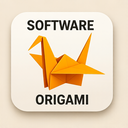
Imagine an icon that transcends the boundaries of digital design, merging three seemingly distinct concepts into a single cohesive symbol: software, camera, and origami. This icon is not merely a visual representation—it is a narrative of technological evolution, creative expression, and digital artistry. At its core lies the essence of modern innovation, where logic meets aesthetics, functionality meets form. Every line and curve in this icon serves a dual or even triple purpose: it conveys meaning while maintaining an elegant balance between complexity and clarity.
The foundation of the icon is a sleek, minimalist software interface element. At the center sits a small, glowing circuit board motif—abstract yet unmistakably digital. This microchip-like shape features subtle hexagonal patterns reminiscent of code syntax or data flow diagrams. The color palette is sophisticated: deep indigo for the base, accented with electric blue and soft white highlights that simulate light emission from active processes. This represents not just the presence of software but its dynamic nature—always processing, always evolving. Embedded within this digital core are faint, glowing lines forming a grid pattern, symbolizing algorithms at work and data streams flowing seamlessly through a digital ecosystem.
Emerging from the top-left corner of this circuit base is a delicate, folded origami crane. The crane’s wings are made of paper-thin geometric shapes that curve outward in perfect symmetry—each fold precise, each edge sharp. The origami crane is not merely decorative; it embodies creativity, precision, and transformation. In Japanese tradition, the origami crane symbolizes peace and longevity, but in this context, it takes on a new meaning: the transformation of ideas into tangible digital forms. The paper appears translucent with subtle gradients—light gray at the base fading to white at the tips—giving it a luminous quality that suggests it is both physical and ethereal. Its wings slightly open as if mid-flight, symbolizing forward motion, progress, and endless possibility.
But what makes this icon truly exceptional is how the camera element integrates with the others. From the crane’s head extends a sleek camera lens that appears to emerge organically from the paper. The lens is not bulky or mechanical but refined—its shape follows a seamless spiral, echoing both biological forms and digital interfaces. The camera body is crafted from thin silver lines that resemble microchips wrapped around glass, blending seamlessly into the origami’s structure. A small aperture circle at the front glows faintly with soft white light—a metaphor for vision capturing not just images, but moments, ideas, and data.
Herein lies the brilliance of design: every component is interwoven. The software provides intelligence and functionality; the camera captures reality in digital form; and origami offers a bridge between nature and technology through craftsmanship. The camera lens points forward toward a symbolic horizon—a line of light that extends beyond the icon's frame—suggesting that this fusion is not static, but constantly moving forward into new frontiers of innovation.
The background of the icon features subtle motion blur effects in deep blue and violet hues, resembling digital noise or data streams. This adds depth without distracting from the main elements. The entire composition feels balanced: neither too minimal nor overly complex. It adheres to modern flat design principles while incorporating tactile, organic details inspired by paper folding.
From a symbolic standpoint, this icon represents the future of digital creation tools—applications that do more than just process information; they capture life through visual language and transform it through intelligent software. Imagine a mobile photography app that uses AI to analyze and suggest edits in real time—its interface would be powered by sophisticated software, its camera captures every moment with precision, and its design philosophy embraces elegance through simplicity (much like origami).
Even the color scheme reflects this harmony: indigo for depth and intelligence (software), white for clarity and light (camera), and soft grayish tones for naturalness and balance (origami). The transitions between colors are smooth, reinforcing the idea of integration rather than separation.
In conclusion, this icon is not just a representation of three elements—it is a manifesto. It proclaims that technology need not be cold or impersonal. With the right blend of software intelligence, photographic vision, and artistic craftsmanship (embodied in origami), digital tools can become extensions of human creativity. This icon stands as a testament to the beauty that emerges when logic meets artistry, when code meets paper, and when every click captures not just an image—but a moment of insight.
It is more than an icon; it is inspiration. It speaks to developers, photographers, designers, and dreamers alike—reminding us that innovation thrives at the intersection of disciplines. And in its elegant form, we see the future: where software powers our world, cameras preserve our memories, and origami teaches us that even from a single sheet of paper—a boundless universe can unfold.
Create your own icon with our GoGPT AI prompt:
GoGPT