

Software Credit card Pixel art Free icon download
Download all to grab every PNG variant.
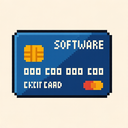
In the vibrant world of digital design, few concepts capture the imagination quite like pixel art—a nostalgic visual language that harks back to the golden era of 8-bit video games. At its intersection with modern technology lies a uniquely compelling icon: a meticulously crafted pixel art representation that seamlessly fuses the themes of software, credit card, and retro digital aesthetics. This icon is not merely a graphic; it is an artifact of digital culture, telling a story about innovation, finance, and the enduring charm of simplicity.
The icon measures precisely 32x32 pixels—a standard dimension in classic arcade games and early computer interfaces—allowing for sharp detail within a constrained canvas. Every pixel is purposefully placed to convey complex meaning with minimal visual noise. The background is a deep slate gray, evoking the cold precision of digital systems, while the main subject stands out with vibrant color contrasts that immediately draw attention.
The central object in this icon is a stylized credit card—its shape unmistakable: rectangular with rounded corners and a slight tilt to suggest depth. However, rather than mimicking a real-world plastic card, it is rendered in an exaggerated, almost cartoonish 8-bit style. The card's surface features a series of blocky pixels arranged to resemble embossed text: "PAY" at the top center in crisp white pixels (using #FFFFFF), with a subtle gradient effect achieved through dithering patterns to suggest light reflection. Below it, the number sequence "4242 1818 9393" is displayed in a monospaced pixel font, each digit meticulously constructed from just five vertical lines of varying height and width—a nod to early digital displays.
Embedded within the card’s surface are symbolic elements that reference software. On the right side of the card, a small pixelated circuit board pattern appears—composed of intersecting red (RGB #FF0000) and yellow (RGB #FFFF00) lines forming geometric shapes such as squares and triangles. These represent data flow, processing power, and digital connectivity. At the top left corner of the card sits a tiny 3x3 pixel "chip" icon—three dark gray pixels arranged in a right-angled triangle—evoking the integrated circuits found in modern payment terminals and secure smart cards.
Beneath this digital hardware element, a subtle but significant detail emerges: a miniature pixelated "play button" (▶), rendered in green (#00FF00), partially embedded into the card’s surface. This is not just decorative—it symbolizes the active role of software in enabling transactions. It suggests that this isn’t just an inert piece of plastic, but a dynamic interface between user and system—an endpoint where code meets commerce.
The credit card's magnetic stripe on the bottom third is rendered with care: a series of alternating black and white pixels forming three horizontal bars, each precisely 32 pixels long. The pixel pattern mimics the actual encoding of data in real magnetic stripes—though stylized for artistic effect. This detail reinforces authenticity while maintaining the icon’s retro aesthetic.
Surrounding the card are subtle indicators of software integration: two small pixel icons floating at top-left and bottom-right corners. One resembles a binary code stream ("1010 1100 0111") in monochrome, representing data input/output. The other is a stylized "shield" icon—six pixels in total, forming an incomplete hexagon with a central dot—to symbolize security features inherent in modern payment software.
Color usage throughout the icon is deliberate and symbolic. The dominant palette includes: bright white for text and highlights; red for data lines (denoting energy or transaction flow); green for software activation (play button, security); gray for metallic sheen; and black as negative space to define edges. This limited yet expressive color scheme enhances legibility while paying homage to the constraints of early gaming systems like the NES or Game Boy.
From a technical standpoint, this icon is built using a strict pixel art grid—no anti-aliasing or gradients beyond dithering patterns. The result is a crisp, scalable image that retains clarity even at small sizes (such as in app icons or toolbars), making it ideal for use in software interfaces across platforms.
Ultimately, this pixel art icon transcends mere visual representation. It embodies the convergence of two critical modern forces: digital finance and software innovation. It reminds users that behind every swipe, tap, or click lies a complex system of code and data—fueled by creative design and rooted in the nostalgic language of early computing. Whether used as an app icon for a fintech startup, a visual metaphor in educational software about digital payments, or simply as an homage to retro tech culture, this icon stands as a testament to how pixel art can elegantly merge function, form, and nostalgia into one powerful symbol.
In an age of high-resolution graphics and AI-generated imagery, this 32x32-pixel masterpiece proves that sometimes the most meaningful designs are born from limitation—where every pixel tells a story, every color carries meaning, and every detail celebrates the enduring fusion of software, credit card, and pixel art.
Create your own icon with our GoGPT AI prompt:
GoGPT