

Software DNA strand Steampunk Free icon download
Download all to grab every PNG variant.
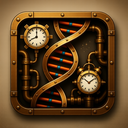
The icon presents a breathtaking fusion of three distinct yet harmoniously interwoven concepts: software, the DNA strand, and steampunk. It is not merely a visual symbol but a narrative artifact—an emblematic representation of the convergence between human innovation, biological complexity, and retro-futuristic engineering. At first glance, the icon evokes an intricate brass mechanism with glowing blue filaments pulsing through its core like electric veins. The central element is a double helix structure, unmistakably representing the DNA strand—yet it is not rendered in a sterile laboratory aesthetic but reimagined as a mechanical marvel crafted from aged copper pipes, interlocking gears, and steam-warmed cogs.
Each turn of the helix is constructed from articulated brass coils that resemble old-style industrial piping. These coils are not rigid; they flex slightly, suggesting movement and organic functionality. Along the length of the DNA structure, minute gear-like nodes are embedded at regular intervals—each one meticulously engraved with binary code patterns (0s and 1s) on their surfaces. These symbols serve as a direct visual bridge to software logic, transforming the biological blueprint into a data-driven architecture. The double helix is not symmetrical in its mechanical form; instead, it subtly curves like a living organism, demonstrating that even in this steampunk interpretation, life and intelligence are intertwined.
The color palette is rich with warmth and depth: aged brass dominates the primary structure, tarnished slightly to suggest centuries of use. Overlaying the brass are veins of electric blue—representing both data flow and biological energy. These glowing filaments pulse gently in rhythm with an invisible heartbeat, simulating a living network. The light emanates from micro-turbines embedded within each DNA coil, their tiny blades spinning slowly as if powered by both steam pressure and digital impulses. In the background, faint etchings of circuit boards are visible—etched onto aged parchment-like material—but they are not modern silicon chips; rather, they resemble Victorian-era schematics with hand-drawn connections and annotated code in archaic script.
At the base of the icon lies a complex control panel—a steampunk interface that mimics both a laboratory console and an ancient computer terminal. It features dials, levers, steam vents, and glass-encased microprocessors shaped like old-fashioned clockwork engines. One large central dial reads “Genetic Iteration 7.3,” suggesting this is not just a static symbol but part of an evolving system—a living software application that interfaces directly with genetic code. The dials are labeled not in English but in a mix of mathematical notation and biological abbreviations, blending scientific precision with mechanical artistry.
Hovering above the DNA helix, like a ghostly guardian or digital spirit, is a transparent holographic interface displaying animated strands of data—floating lines of code that wrap around the physical structure. These are not arbitrary; they represent actual genetic algorithms and software protocols used in bioinformatics or synthetic biology platforms. The software aspect is further emphasized by small windows within the brass casing that display real-time diagnostics: “DNA Synthesis in Progress,” “Neural Feedback Loop Active,” and “Steam Pressure Stabilized – 94%.” These labels blend mechanical language with digital precision, reinforcing the icon’s theme of hybrid intelligence.
Surrounding the central helix are smaller, secondary elements—miniature steam engines that resemble DNA base pairs: one set shaped like a gear pair (representing Adenine and Thymine), another as interlocking cogs (Cytosine and Guanine). These micro-mechanical units rotate slowly, driven by steam generated from a tiny boiler embedded in the icon’s lower frame. The boiler is visible through a glass panel, filled with glowing liquid that simulates both DNA fluidity and energy source—perhaps an alchemical mixture of water, light particles, and quantum data.
The entire composition is framed within an ornate brass casing reminiscent of a Victorian-era microscope or laboratory apparatus. The casing is engraved with symbols from early computing (such as the punched card) intertwined with biological motifs like mitosis and protein folding. The craftsmanship is exquisite: every screw, rivet, and valve appears hand-fitted by a master artisan who understands both engineering and biology.
In essence, this icon transcends its visual form to become a metaphor for the future of technology—where software doesn’t just manage life but co-evolves with it. It represents advanced bio-computing systems that use genetic algorithms to solve complex problems, where data is encoded not in silicon but in DNA, and where the machines themselves are built with aesthetic reverence for both nature and history. The steampunk element gives it a soul—a sense of craftsmanship and storytelling missing from modern digital icons. It speaks to a world where progress is not just fast but meaningful, where innovation is as beautiful as it is intelligent.
This icon stands not only as a symbol for software platforms in genomics, synthetic biology, or artificial life research—but also as a philosophical statement: that humanity’s greatest achievements lie at the intersection of science, artistry, and imagination.
Create your own icon with our GoGPT AI prompt:
GoGPT