

Software Drum Glassy Free icon download
Download all to grab every PNG variant.
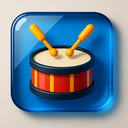
The Glassy Drum Software icon is a masterful synthesis of three distinct yet harmoniously integrated concepts: **Software**, **Drum**, and **Glassy**. It serves not merely as a visual representation for digital music production tools, but as a symbolic gateway into the convergence of technology and artistic expression. This icon transcends its basic function as an interface element; it embodies the soul of modern sound design, where digital precision meets human creativity. At its core, this icon is designed to represent advanced **software**—specifically software dedicated to rhythm creation, beat programming, and audio manipulation. The interface it symbolizes is a powerful digital audio workstation (DAW), a virtual studio built entirely within the constraints of code and computation. It speaks to developers who craft algorithms capable of simulating real-world acoustic phenomena, allowing users to program intricate rhythms with unparalleled accuracy. The software aspect is not just implied—it's reinforced through subtle geometric patterns that mimic circuitry and data flow, subtly integrated into the icon’s structure like veins carrying digital lifeblood. Yet, unlike traditional software icons that rely on rigid grids or abstract geometric shapes, this icon breaks away from convention by centering around a **drum**. More specifically, it features a stylized drum kit element—most prominently a snare drum or tom-tom—rendered with such elegance that it appears to have been sculpted from crystal. The drum is not merely an object within the composition; it is the focal point, the heart of the icon’s design philosophy. Its surface reflects light in a way that suggests extreme clarity and depth, as if one could peer into its inner workings—revealing a complex web of digital waveforms pulsing beneath its polished shell. The drum itself is rendered with sharp edges and clean lines, but these are softened by the **glassy** aesthetic that defines every surface. The entire icon emanates an ethereal sheen, as though coated in liquid glass or frosted quartz. This glossy finish does more than enhance visual appeal; it communicates a sense of transparency, fragility, and precision—qualities that mirror the delicate balance required in both sound engineering and software architecture. Each reflection on the drum’s surface seems to contain micro-versions of musical notation, MIDI sequences, or waveform graphs: digital fragments embedded within the glass like memories trapped in amber. The glassy texture is not uniform; it varies subtly across different parts of the drum. The rim might possess a slightly rougher, more textured appearance—evoking the real-world feel of a metal snare hoop—but even this is softened by a translucent glaze that suggests an otherworldly durability. The center of the drumhead, where sound is generated, appears almost liquid—shimmering with iridescent color shifts that mimic Doppler effects and harmonic overtones. These dynamic reflections change depending on the angle of view or context in which the icon appears (e.g., light mode vs dark mode), giving it an almost living quality. This interplay between **software** and **drum** is not just visual—it's conceptual. The drum represents rhythm, emotion, and physicality; the software represents control, automation, and innovation. Together, they symbolize how technology has become an extension of human expression in music. The glassy surface acts as a metaphor for clarity of vision—both in programming logic and sonic intention. A developer sees the code behind the drum’s behavior; a musician sees their beat come alive through digital precision. The color palette reinforces this duality. Cool blues and silvers dominate, evoking both the cold efficiency of code and the cool elegance of glass. Yet, warm highlights—soft golds or deep ambers—pulse faintly within the drumhead, suggesting warmth, life, and energy. These hues are not static; they react to user interaction in animated versions of the icon (e.g., when a beat is triggered or a plugin loaded), simulating vibrations and resonance through color modulation. Even the background space around the icon is carefully considered. In some representations, it might feature faint circuit lines that resemble audio waveforms, subtly reinforcing the software connection. In others, it dissolves into an infinite depth—a void of glass where light bends unnaturally, suggesting that this drum exists in a digital realm beyond physical laws. Ultimately, the Glassy Drum Software icon is a testament to how design can capture abstract ideas through tangible form. It encapsulates the essence of modern music software: powerful yet elegant, logical yet expressive. The **drum** grounds it in human rhythm and emotion; the **software** gives it infinite potential for innovation; and the **glassy** finish elevates it into a realm of beauty, fragility, and transparency. In an age where technology often feels cold and impersonal, this icon reminds us that digital tools can also be objects of art—where code meets sound, where glass reflects light like music refracts emotion. It is not just an icon; it is a statement. A declaration that software does not have to be sterile, drumming does not have to be mechanical, and design does not have to sacrifice soul for precision. This is the Glassy Drum Software icon: a symphony of form, function, and feeling—crafted in glass, powered by code, and alive with rhythm.
Create your own icon with our GoGPT AI prompt:
GoGPT