

Software Factory Pixel art Free icon download
Download all to grab every PNG variant.
```html
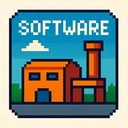
The pixel art icon titled "Software Factory" is a meticulously crafted digital illustration that masterfully blends the themes of software, factory, and the distinctive aesthetic of classic pixel art. Created with deliberate attention to detail within a limited 16x16 or 32x32 pixel grid, this icon transforms complex industrial and technological concepts into a visually coherent, nostalgic yet forward-looking representation. The artwork captures the essence of modern digital production—where lines of code are manufactured like factory goods—and does so with the charm and constraints of early computer graphics.
At first glance, the icon presents a stylized miniature factory structure rendered entirely in 8-bit pixel precision. The building itself is constructed from layered pixels, evoking retro video game architecture. Its base consists of dark gray and charcoal tones for stability, while upper levels feature bright yellow and white accents suggesting industrial activity. A small chimney emits delicate smoke made of pixelated clouds—each puff composed of four or five carefully placed light gray pixels—gently rising upward to suggest the continuous operation of production lines.
Central to the icon is a large, glowing circuit board pattern that spans across the factory’s roof. This element symbolizes software development: intricate pathways and nodes represent data flow, while pulsating blue and cyan pixels form dynamic connections—mirroring the way software components interact in real-world systems. The circuit pattern is not merely decorative; it serves as a visual metaphor for digital creation. Just as factory conveyor belts move physical products from station to station, this digital network moves data and logic across code modules.
On the front façade of the building, two large pixelated windows are visible—each displaying animated sequences. The left window shows a simple text editor interface: lines of monospaced code (represented in green and white pixels) appear line by line, mimicking a developer typing in real time. The right window reveals a debugging console where red error messages flash intermittently before being resolved into green checkmarks—further emphasizing the iterative, production-line nature of software engineering.
Adjacent to the factory entrance stands a mechanical arm composed entirely of pixel blocks—its movements are implied through motion blur effects made possible by strategic pixel placement. This robotic element is not a literal assembly robot but a symbolic representation of automated testing and deployment systems. Its gripper holds a small, glowing cube that represents an executable file or software package—a finished product ready for delivery.
The factory floor below the building is not empty; it features horizontal conveyor belts made of alternating dark and light pixels that simulate motion. These belts carry tiny pixelated icons representing various software components: databases (a small grid), user interfaces (a stylized smartphone screen), algorithms (mathematical symbols in code font), and APIs (interlocking gears). This detail reinforces the industrial theme—the factory metaphor for software development, where code is designed, tested, compiled, and delivered through standardized processes.
The background of the icon uses a subtle gradient from deep blue to purple—evoking both digital space and night-time factory lighting. In the distance, faint pixelated stars add depth without distracting from the central subject. The entire scene is framed by a simple border composed of light gray pixels, giving it an authentic retro game interface feel.
What makes this icon particularly compelling is how it seamlessly integrates all three keywords: software through its digital elements and coding references; factory via the industrial structure, conveyor belts, mechanical arms, and production-line logic; and pixel art through every line of code in the design—the intentional grid-based composition, limited color palette (typically 16–256 colors), and deliberate use of dithering for gradients.
When viewed at actual size—especially in a retro-themed app icon, game interface, or developer dashboard—this pixel art icon functions not just as a visual symbol but as a narrative: it tells the story of how raw code becomes polished software through systematic, repeatable processes. It celebrates both the craftsmanship of programming and the efficiency of modern digital manufacturing.
Ultimately, "Software Factory" is more than an icon; it’s a micro-story told through pixels. In its small dimensions lies a universe of meaning—a fusion of technology and tradition, where ancient pixel aesthetics breathe new life into contemporary themes of software creation and industrial-scale digital innovation.
```Create your own icon with our GoGPT AI prompt:
GoGPT