

Software Factory Steampunk Free icon download
Download all to grab every PNG variant.
```html
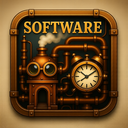
The Steampunk Software Factory icon is a masterful synthesis of three distinct yet harmonious concepts—software, factory, and steampunk—crafted to represent the evolution of digital technology through the lens of industrial revolution aesthetics. This intricate icon transforms abstract notions of computing into a tangible, mechanical marvel that captures both the soul of innovation and the grittiness of an age where brass gears met burgeoning intellect.
At first glance, one is struck by its ornate complexity. The central figure resembles a massive, intricately detailed control console forged from aged copper and polished iron. The surface is etched with swirling patterns reminiscent of circuitry, but rendered not as sleek silicon pathways—instead they are channeled through brass tubing and engraved metal plates that resemble vintage blueprints. These "circuits" aren't silent data pathways; they glow with a warm, amber luminescence, pulsing rhythmically like the heartbeat of a mechanical mind. This glowing effect is achieved through delicate glass tubes filled with vapor—a subtle nod to early scientific experiments—infused with faintly electric light that flickers in sync with imaginary processing cycles.
The icon's foundation is clearly industrial: a towering, multi-tiered factory structure, built not from concrete but from stacked brass and iron platforms. Each level of the factory represents a different layer of software development. The bottom floor features massive, piston-driven printers that stamp out code in cursive script on parchment-like sheets—each page glowing faintly with the syntax of a programming language rendered in steampunk calligraphy. Above this, gears turn slowly but precisely, each one inscribed with symbols representing algorithms and data structures: loops become revolving cogs; conditional statements manifest as adjustable valves that regulate the flow of information like steam through pipes.
What elevates this icon beyond mere visual metaphor is its integration of functional steampunk mechanics. A large, central gear—the "core processor"—spins at the heart of the structure, driven by a miniature steam engine housed beneath. This engine is not just decorative; it’s a working aesthetic representation of computational power. Pipes radiate from it like neural pathways, carrying not steam but streams of light—each beam representing a data packet flowing through an invisible network. The sound effect (if this were animated) would be the low hum of pistons, the hiss of regulated vapor, and the rhythmic clatter of mechanical clocks keeping time with software execution.
Software is not merely represented—it is embodied. The interface isn’t a flat screen but a multi-layered dashboard: dials calibrated to measure code efficiency, pressure gauges indicating system load, levers labeled “Debug,” “Compile,” and “Deploy.” Even the keyboard, if visible in detail, consists of brass keys that rise and fall with mechanical precision when pressed—each keystroke producing a satisfying click as if a tiny piston is actuating beneath. The monitor screen (if included) appears as an old-fashioned glass sphere suspended within a brass cage, its surface displaying lines of code written not in ASCII but in cursive Gothic script, shifting like live data streams through gears.
Factory elements are omnipresent and deeply integrated. Conveyor belts made of interlocking iron plates carry components—tiny mechanical processors shaped like cogwheels and circuit boards crafted from engraved metal—assembled by miniature robot arms with articulated brass limbs. These arms move in precise, synchronized patterns, resembling clockwork choreography. Overhead cranes hoist stacks of “software modules” suspended on chains, each one labeled with names like “Kernel,” “GUI Framework,” or “Cloud Sync Engine.” The factory is not idle; it’s a living machine that produces digital solutions through physical labor.
Finally, the steampunk aesthetic is not merely a stylistic choice—it’s philosophical. This icon represents the idea that software, despite its intangible nature, can be seen as an engineered creation born from human ingenuity and industrial effort. The fusion of steam-powered mechanics with digital logic suggests that modern computing is a descendant of mechanical invention—the logical extension of clocks, telegraphs, and early automation into the realm of electrons and algorithms.
In essence, the Steampunk Software Factory icon transcends its role as a mere graphic element. It stands as an emblem of evolution: where ancient craftsmanship meets future thinking; where industrial might fuels digital dreams; where every cog turns not just to move metal—but to run code. It is a tribute to the unseen labor behind software development, rendered visible through the lens of retro-futurism. In a world increasingly dominated by invisible data streams and abstract cloud infrastructure, this icon reminds us that innovation has always been built on tangible foundations—and sometimes, those foundations are forged in brass, steam, and imagination.
```Create your own icon with our GoGPT AI prompt:
GoGPT