

Software Guitar Minimalist Free icon download
Download all to grab every PNG variant.
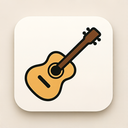
The minimalist software guitar icon represents a harmonious fusion of digital technology and musical expression through an elegant, understated design language. At its core, this icon encapsulates the essence of modern software interfaces while paying homage to the timeless instrument—the guitar—through carefully distilled visual elements. The integration of these seemingly disparate concepts—software functionality and musical artistry—results in a symbol that speaks to both technological innovation and creative soul.
Visually, the icon adheres strictly to minimalist principles. It employs clean lines, geometric precision, and a restrained color palette dominated by monochromatic tones such as deep charcoal gray or soft white on a transparent background. The absence of ornate details, gradients, or elaborate textures emphasizes clarity and purpose—a hallmark of contemporary software design philosophy. Every line serves a functional role; no element is superfluous. This deliberate simplicity reflects the way modern software applications are designed: intuitive, efficient, and focused on user experience without visual clutter.
The guitar element is abstracted to its essential form through geometric simplification. Rather than depicting a realistic instrument with strings, frets, and intricate body contours, the icon presents a stylized silhouette that captures the core identity of a guitar. A smooth, curved shape resembling the lower bout of an acoustic guitar forms the base—the organic curve suggesting both soundwave resonance and natural elegance. Above it sits a narrower parallelogram representing the neck, with two angular cutouts symbolizing tuning pegs or string anchors, all rendered with sharp precision to convey modern digital craftsmanship.
One of the most compelling aspects of this icon is how it subtly integrates musical symbolism into a software context. The guitar’s body contains three evenly spaced horizontal lines within its curved form—these are not mere decorative strokes but serve as visual metaphors for audio waveforms or note representations. In a digital interface, these lines could represent active sound processing, audio signal visualization, or even the display of music notation in an integrated software application. This dual meaning—both musical and technological—elevates the icon beyond a simple representation into a symbol of convergence between art and code.
The minimalist approach extends to the icon’s functionality within digital environments. Designed for scalability, it maintains its clarity even at tiny sizes (as small as 16x16 pixels), making it ideal for software applications like music production tools, audio editing platforms, or digital instrument simulators. Its lack of fine details ensures that it doesn’t pixelate or lose definition when rendered on low-resolution screens or in compressed formats—critical for seamless integration across devices and operating systems.
Functionally, this icon is not just a visual element but a conceptual bridge. It suggests software that empowers musicians with intuitive tools to compose, record, and manipulate music digitally. Imagine it as the interface symbol for an app that turns your smartphone into a virtual guitar studio—offering effects processing, chord recognition, or real-time feedback on performance accuracy. The minimalistic design ensures users are not distracted by visual noise but instead focus on the creative process facilitated by the software.
The color scheme further reinforces its minimalist character while allowing room for contextual adaptation. In a dark-mode application, the icon appears in crisp white or light gray, glowing subtly against a black background to draw attention without overwhelming. In light-mode designs, it might be rendered in a soft charcoal tone to blend elegantly with other interface elements. This adaptability underscores how the icon functions not just as an image but as a responsive component of a larger software ecosystem.
Furthermore, the icon’s composition follows principles of balance and symmetry—key tenets of minimalist design. The guitar silhouette is centered, with its proportions adhering to golden ratio guidelines, creating visual harmony. The horizontal lines within the body are spaced equidistantly, contributing to a sense of rhythm and order that mirrors musical structure itself. This intentional alignment reflects the underlying logic of software architecture: precision, predictability, and elegance in execution.
Ultimately, this minimalist software guitar icon transcends mere representation. It embodies a philosophy—where technology serves creativity rather than overshadowing it. In a world saturated with complex digital interfaces, this icon stands out not through embellishment but through purity of form and purpose. It speaks to developers who value simplicity in design and musicians who seek digital tools that feel as natural as playing an acoustic instrument. By merging the soul of the guitar with the intelligence of software—through a minimalist lens—the icon becomes more than a symbol; it becomes an invitation: to create, to innovate, and to listen.
Create your own icon with our GoGPT AI prompt:
GoGPT