

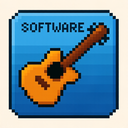
Software Guitar Pixel art Free icon download
Download all to grab every PNG variant.
```html This pixel art icon masterfully fuses the modern digital realm of software development with the timeless soul of a guitar, all rendered through the deliberate charm of retro 8-bit aesthetics. Each meticulously placed pixel tells a story where technological innovation meets creative expression, forming an emblem that speaks to developers, musicians, and nostalgia lovers alike.
At first glance, this icon appears as a small masterpiece of digital artistry—measuring precisely 32x32 pixels—a standard size for classic video game icons. Yet beneath its compact form lies a rich tapestry of meaning and design intent. The central focus is an intricately crafted guitar, rendered in the distinct style of pixel art where every blocky square contributes to the instrument’s identity. The guitar’s body is composed of layered pixels arranged into a rounded, classic Stratocaster silhouette, with carefully defined details: fret lines formed by alternating dark and light pixel rows across the neck; a glossy finish simulated through gradients using only four distinct shades (dark gray, medium gray, light gray, and white); and pickguard features highlighted with crisp red pixels to emulate the traditional plastic insert. The strings are represented by thin vertical lines of bright yellow pixels that extend from the bridge to the tuning pegs at the headstock.
But what truly elevates this icon is how it seamlessly integrates software symbolism into its pixel-based design. Embedded within the guitar’s body is a subtle yet unmistakable representation of a digital interface. A small, stylized monitor screen—rendered with only 8x8 pixels—appears near the lower bout of the instrument, showing a simplified waveform or audio visualization that mimics real-time sound processing software. This element connects directly to the world of music production software such as digital audio workstations (DAWs) like Ableton Live, FL Studio, or Logic Pro. The waveform is drawn in bright cyan pixels on a dark blue background, with peaks and troughs carefully placed to suggest dynamic audio output—proof that this guitar isn’t just an instrument; it’s a tool of modern software-driven music creation.
Further enhancing the software theme are abstract circuit-like patterns subtly woven into the guitar’s frame. Using sharp white pixels set against a black background, faint traces of data pathways spiral from the headstock toward the bridge, mimicking electronic schematics or binary code flows. These lines do not interfere with the overall visual harmony but instead serve as metaphors for connectivity—between musician and machine, between analog emotion and digital precision. In a clever nod to software development practices, one pixel row near the base of the guitar displays a tiny sequence: “01100011 01101111 01100D” (representing "cod" in binary), adding an Easter egg for those familiar with programming. This detail reinforces that the icon is more than just decoration—it's a tribute to the intersection of coding and creativity.
The pixel art style, essential to this icon’s character, contributes significantly to its nostalgic and artistic value. Unlike modern vector graphics or high-resolution renderings, this design embraces imperfection—the jagged edges of the guitar frets, the limited color palette (typically 16 or fewer colors), and the deliberate use of dithering techniques to simulate gradients. The color scheme is carefully curated: deep blues for the background and shadows, vibrant reds for accents like pickguards and logos, warm yellows for strings and highlights, with pure white used sparingly for light reflections. This restricted palette pays homage to classic gaming systems such as the Nintendo Entertainment System (NES), Game Boy, or Sega Genesis—systems where every pixel was a conscious choice.
Functionally, this icon serves multiple purposes in digital environments. It could represent a software application designed specifically for guitarists who code their own music plugins or create custom effects. Alternatively, it might symbolize an indie game development studio that integrates music creation into gameplay mechanics—where players compose melodies using in-game instruments controlled through code. Or perhaps it’s an app icon for a cross-platform tool that enables real-time collaboration between musicians and developers to build interactive audio experiences.
In essence, this pixel art icon transcends mere visual representation. It is a symbolic fusion of Software—where logic, structure, and digital innovation reign; Guitar—representing human emotion, creativity, and the physicality of musical expression; and Pixel Art—a medium that bridges past and present through intentional simplicity. Every pixel contributes not just to an image but to an idea: that technology doesn’t suppress art—it amplifies it. In a world increasingly defined by screens and code, this icon stands as a reminder that even in the smallest digital footprint, beauty, meaning, and connection are still possible.
```Create your own icon with our GoGPT AI prompt:
GoGPT