

Software House Retro Free icon download
Download all to grab every PNG variant.
At the heart of digital culture lies a vibrant fusion of past and present—where classic design aesthetics meet cutting-edge technology. This icon, titled "Retro Software House," masterfully embodies this harmonious blend by intricately weaving together three key themes: Software, House, and Retro. It stands not merely as a visual element but as a storytelling device—a digital artifact that evokes the spirit of early computing, the comfort of home, and the enduring legacy of innovation.
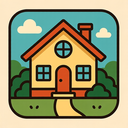
The central motif of the icon is a stylized house, rendered in a vintage 1980s aesthetic. The structure resembles a quaint cottage with a steeply pitched roof, wooden shingles, and small rectangular windows bordered by simple black frames—design elements reminiscent of early computer graphics and pixel art. The house is slightly skewed to the left, giving it an animated tilt that suggests motion or activation—like a system booting up. Its front door is slightly ajar, revealing a warm golden glow from within, symbolizing welcome and accessibility in the digital space.
What makes this house more than just architecture is its role as a metaphor. In the digital age, software often feels impersonal or distant—remote servers and abstract code lines. But this icon reclaims that intimacy by framing technology as something domesticated, familiar, and safe. The house represents not only a physical space but also the emotional sanctuary of software: where ideas are nurtured, data is protected, and creativity flourishes.
The true magic of the icon lies in its integration with software symbolism. Embedded into the roof of the house are faintly glowing pixelated circuit lines that resemble a vintage motherboard or data flow map. These lines pulse gently in a soft cyan-blue hue, mimicking real-time data transmission and giving the impression that code is actively running beneath this humble dwelling.
From the chimney rises a spiral of ascending dots—each one representing an individual line of code being executed. The dots form a subtle trail upward into the sky, resembling both binary sequences and star trails. This visual metaphor suggests that software isn’t confined to machines; it’s an evolving entity, growing like a tree from the foundation of this digital home.
On the house's roof sits a small antenna shaped like old CRT TV aerials—another nod to retro technology. It captures not radio waves, but streams of data packets. This element reinforces the idea that software is both broadcast and received: it reaches users through networks, while also being built from user input and community collaboration.
Even the windows are alive with meaning. Each pane contains a tiny icon: a floppy disk in one corner (representing storage), a terminal prompt blinking in another (symbolizing command-line interaction), and an abstract representation of an algorithm flowing through the third. These details invite closer inspection, rewarding users with layers of digital history hidden beneath the surface.
The retro aspect of this icon is not merely decorative—it’s foundational. The entire design speaks the visual language of early personal computing: low-resolution graphics, limited color palettes, and hand-crafted textures. The color scheme draws inspiration from 8-bit video game consoles like the NES and Game Boy—earthy browns for the roof, pale green for windows, muted sky blue for the background sky.
Textures are intentionally pixelated. Every edge of the house is slightly jagged, embracing imperfections that were once limitations but now become virtues. The shadow beneath the house is not smooth—it’s built from a series of small squares, echoing raster graphics and early sprite animation techniques.
Even the font used in any accompanying text (if present) would be a retro monospaced typeface—like those found on vintage terminals or old BASIC programming environments. The icon might even subtly include an "error message" banner tucked into one corner: “System Running... v1.2 (1987)” — a cheeky nod to software versioning from the past.
Beyond its technical and aesthetic merits, this icon holds deep emotional resonance. For those who grew up during the dawn of personal computing—the 1980s and early '90s—it evokes memories of tinkering with home computers, writing simple programs in BASIC, or spending weekends exploring new software on floppy disks.
For younger users, it serves as a cultural artifact—a bridge to understanding where technology came from. It reminds us that behind every modern app, cloud service, or AI model lies a foundation built by dreamers who once worked in garages and living rooms with nothing but curiosity and old manuals.
In today’s world of sleek interfaces and invisible infrastructure, this icon stands as a celebration of origin stories. It says: "This is where it began. This is where innovation lived not just in labs, but in homes—where people wrote code on typewriters, saved work to cassette tapes, and believed that one day their machines could change the world."
The "Retro Software House" icon is more than a graphic—it’s a manifesto. It fuses the warmth of home with the intelligence of software and pays homage to a bygone era with reverence and playfulness. In an age where digital experiences are increasingly abstract, this icon grounds us in memory, craft, and meaning.
It reminds us that technology doesn’t have to be cold or complex—it can be cozy, familiar, and full of heart. Whether used in an app for retro gaming enthusiasts, a software development tool for beginners, or a nostalgic branding element for indie tech startups—this icon speaks to both the past and the future. It is a digital homecoming: where software lives not in distant servers but in our collective memory—and where every line of code begins with a spark of human imagination.
Create your own icon with our GoGPT AI prompt:
GoGPT