

Software Piano 3D isometric Free icon download
Download all to grab every PNG variant.
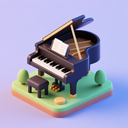
The icon presented here is a masterfully crafted representation that seamlessly blends the digital world of software with the timeless elegance of musical expression through a piano, rendered in a sophisticated 3D isometric perspective. This design transcends mere visual representation; it embodies a conceptual fusion between technology and artistry, capturing the essence of modern music production software in an aesthetically rich and instantly recognizable form.
At its core, this icon is fundamentally defined by its 3D isometric style—a perspective technique that creates a three-dimensional illusion on a two-dimensional surface by using parallel projection with equal angles between the axes (typically 120 degrees). The result is an image that appears to have depth and dimensionality while maintaining consistent scaling across all planes. In this particular icon, the 3D isometric approach provides not just visual appeal but functional clarity. Each component of the piano—the keys, frame, pedals, and internal structure—is rendered with precise geometric relationships that allow viewers to immediately understand spatial arrangements without any need for labels or context.
The piano itself serves as both the literal and metaphorical centerpiece of this icon. It is depicted not as a generic or stylized keyboard, but as a detailed, realistic grand piano rendered with meticulous attention to architectural integrity. The instrument’s elegant curves are faithfully translated into the 3D isometric format—its polished black finish reflects subtle lighting gradients that enhance depth perception. The lid is partially opened, suggesting activity and creativity in progress. Each key is clearly visible: the white keys slightly recessed, and the black keys raised with a precise rectangular form that maintains correct proportional spacing according to real-world piano design principles.
What makes this icon particularly compelling is how it integrates technological elements into its physical structure. Embedded within the piano’s frame are subtle yet unmistakable indicators of digital functionality—small LED lights glowing at regular intervals along the side panel, suggesting active processing or status indicators. A sleek, minimalist control interface appears on the right side of the instrument: a series of small touch-sensitive buttons and a circular rotary knob reminiscent of modern digital audio workstations (DAWs). These elements are not mere decorations but integral design features that communicate functionality. They suggest this is not just a physical piano, but one deeply connected to software-driven music creation.
Even more intriguing is the way the software aspect manifests through visual metaphors rather than literal representations. Instead of showing a screen or interface directly, the icon implies software presence through abstract data streams that seem to emanate from beneath the piano's keys and flow upward into space. These are rendered as delicate, glowing lines in varying shades of blue and purple—like digital particles dancing mid-air—each one curving gracefully to form subtle patterns reminiscent of sound waves or code syntax. The movement suggests real-time processing: every key press triggers a corresponding digital ripple, visually linking human interaction with instantaneous software response.
The 3D isometric perspective also enables the icon to communicate complexity without clutter. From the chosen angle, viewers can see not only the front face of the piano but also its side profile and even parts of its internal frame. This allows for layered storytelling: while one might first notice the piano’s polished surface, a closer look reveals tiny circuit-like patterns etched into its wooden grain—symbolizing embedded electronics or digital signal pathways. The pedals are rendered with mechanical precision, their linkages visible in cross-sections that hint at sophisticated software control systems governing dynamics and sustain.
Color choices further reinforce the icon’s dual nature. A cool, professional palette dominates: deep navy blue accents contrast with warm walnut tones in the piano woodwork and bright, electric cyan highlights where digital elements intersect with physical form. This combination evokes both sophistication (blue) and organic craftsmanship (wood tones), reflecting the harmony between human artistry and technological innovation.
Functionally, such an icon would be ideal for a software application designed for music composition, virtual piano simulation, or digital audio production. Its 3D isometric format ensures clarity at small sizes—a crucial requirement for app icons and UI elements—while remaining rich in detail when viewed at larger dimensions. The fusion of tangible physicality with intangible digital processes makes it instantly memorable and emotionally resonant: it speaks to musicians who value the tactile experience of playing a piano, while also appealing to tech-savvy creators who appreciate seamless software integration.
In conclusion, this 3D isometric icon successfully merges three essential elements—Software, Piano, and 3D Isometric—into a cohesive, meaningful visual narrative. It is not merely an image of a piano or an icon for music software; it is a symbolic representation of the modern creative process itself: where physical inspiration meets digital execution through intelligent technology, all rendered with precision and elegance in a visually compelling 3D space.
Create your own icon with our GoGPT AI prompt:
GoGPT