

Software Road Minimal outline Free icon download
Download all to grab every PNG variant.
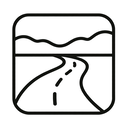
The icon is a masterful fusion of digital innovation and physical connectivity—representing the modern intersection between software technology and the infrastructure that powers it. Designed with a strict adherence to minimalism, this icon uses clean lines, negative space, and restrained color palettes to convey complex ideas in an elegant, universally understandable form. At its core lies a harmonious balance of three essential elements: Software, Road, and the overarching philosophy of Minimal Outline. Together, they create a symbol that speaks to the digital age's relentless progress while maintaining timeless visual clarity.
The central theme is rooted in software—an intangible yet omnipresent force shaping how we live, work, and communicate. The icon captures this essence not through literal depictions of code or circuit boards but through an abstract metaphor: a winding road that emerges from the digital realm. This subtle choice transforms the concept of software from something invisible into a tangible journey—a path that guides users forward in their technological endeavors. The road is not merely a background element; it is the narrative engine of the icon, symbolizing navigation, progress, evolution, and connectivity—all key attributes associated with software development and deployment.
Every curve and line of the road has been meticulously crafted to reflect minimal outline design principles. There are no gradients or textures—only a single continuous stroke in a solid hue (typically a soft blue or dark gray) that defines both the road’s shape and its movement through space. The line is thin, precise, and consistent in width, emphasizing clarity over complexity. This minimalism serves not as an artistic constraint but as a strategic choice: to ensure immediate recognition across devices of varying screen sizes and resolutions—from smartphone lock screens to high-resolution dashboards.
The road begins subtly at the bottom left of the icon's frame, suggesting origin or inception—the moment software is conceived in code. It snakes upward and diagonally toward the top right, a trajectory that symbolizes growth, advancement, and forward momentum. This directional flow aligns with user intuition: we naturally expect progress to move from left to right and bottom to top in visual storytelling. The path isn’t straight—its gentle curves mimic the non-linear nature of software development: iterative updates, feedback loops, version releases—and the inevitable detours that come with innovation.
What makes this icon truly distinctive is how it integrates physical road imagery into a digital context without becoming literal or distracting. The road does not feature lanes, signs, or vehicles—elements that would introduce visual clutter and detract from minimalism. Instead, the path is implied through the continuous line and slight thickening at key turning points to suggest directionality and change in course. These subtle inflections are enough to communicate complexity without compromising simplicity.
The software aspect is embedded not in what is drawn but in how it’s interpreted. The road becomes a metaphor for data flow, API integration, cloud connectivity, or even the lifecycle of an application—from conception to deployment and beyond. It suggests that software isn’t just code—it’s a journey built on infrastructure and pathways that allow information to travel efficiently and securely. In this way, the icon bridges abstraction and functionality: it doesn’t show a server farm or a database diagram; instead, it evokes the idea of structure underlying digital services through the universal symbol of a road.
Minimal outline design is not just about aesthetics—it’s about purpose. Every line serves dual roles: defining form while also guiding attention. There are no redundant shapes or decorative flourishes. The icon achieves maximum meaning with minimum visual elements, making it ideal for use in UIs where space is limited and clarity is paramount. This efficiency ensures that the icon remains legible even at tiny sizes—essential for modern application interfaces that demand responsive and scalable design.
Color plays a crucial supporting role, but never overwhelms. The road line is typically rendered in a single, neutral tone—either a cool blue (evoking trust and technology) or deep gray (suggesting sophistication and neutrality). In some variations, the background may be white or light gray to enhance contrast and readability. This restrained palette reinforces the minimal nature of the icon while allowing it to integrate seamlessly into diverse design ecosystems—from dark mode interfaces to minimalist branding.
Ultimately, this icon is more than a visual symbol; it’s a conceptual statement. It represents how software—despite being intangible—relies on tangible infrastructure. Just as roads connect cities and enable movement, software connects users, devices, and systems across the globe. And in its minimal outline form, it stands as a testament to design excellence: where less truly is more. It speaks to developers who understand the journey of building digital products; to users who navigate through apps with ease; and to designers who value clarity and intentionality.
In an era defined by digital overload, this icon reminds us that simplicity can carry profound meaning. By merging the abstract world of software with the concrete image of a road—all wrapped in a minimal outline—this design becomes a powerful emblem of modern connectivity: efficient, forward-looking, and effortlessly understandable.
Create your own icon with our GoGPT AI prompt:
GoGPT