

Software Robot Line art Free icon download
Download all to grab every PNG variant.
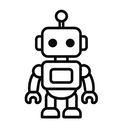
The icon described herein is a meticulously crafted digital symbol that embodies the convergence of modern technology and artistic simplicity. At its core, it represents a harmonious blend of software, robot, and line art, each element carefully balanced to create an image that is both conceptually rich and visually striking. This icon is not merely a representation of technology but a visual narrative—telling the story of digital intelligence, automation, and human innovation through clean, elegant lines.
At its foundation lies the concept of software. This is not portrayed through traditional depictions such as code snippets or binary strings but rather through abstraction. The icon’s form suggests an underlying digital architecture—implying structure, logic, and connectivity without literal representation. The central figure—a stylized robot—is composed of geometric shapes that resemble circuitry patterns: thin connecting lines mimic data flow, while angular joints reflect the modular nature of software systems. These elements are not decorative; they are integral to the icon’s meaning.
The robot's body is segmented into distinct zones—head, torso, arms—each defined by precisely drawn lines that suggest internal components like processors and memory units. The absence of color (or presence of monochrome) reinforces the digital nature of software: no visual distractions from the essential logic behind it. The icon communicates that this robot isn't just a mechanical entity but a sentient program—an autonomous agent powered by code, designed to perform tasks, learn, adapt, and evolve.
Moreover, subtle details such as micro-circles along certain line segments resemble data nodes or signal points. These are not random; they represent the interconnectedness characteristic of modern software ecosystems—cloud-based services, APIs, and networked intelligence. The entire icon functions as a metaphor for an intelligent application: efficient, scalable, and self-aware in its operation.
The robot aspect of the icon is central to its identity. However, this robot is not depicted in a hyper-realistic or mechanical style. Instead, it adopts a minimalist approach that emphasizes form over texture or material. The robot’s design draws inspiration from classic industrial robotics—think robotic arms used in manufacturing—but with a futuristic twist.
Its limbs are elongated and articulated with clean joints defined by single, unbroken lines—symbolizing precision and control. The head is simplified into a rounded rectangle with two symmetrical dots for eyes, evoking both curiosity and awareness. Unlike traditional robots that may appear cold or mechanical, this one has a subtle human-like quality: the gentle curve of its torso suggests approachability; the slight forward tilt of its body implies intentionality and engagement.
Notably, the robot's feet are not grounded in a rigid base but instead rest on faintly drawn lines that extend outward—symbolizing mobility and connectivity. This design choice reinforces that this is not a stationary machine but an intelligent agent capable of navigating digital environments, moving through data landscapes, or interfacing with multiple systems simultaneously.
The robot’s overall posture conveys readiness: arms slightly extended, as if interacting with invisible interfaces. It’s not just watching or observing—it’s actively computing and responding. In this way, the icon captures the essence of modern robotics integrated into software ecosystems—robots that exist not only in factories but also in virtual assistants, autonomous vehicles, and AI-driven platforms.
The line art style is not merely a design preference—it’s a fundamental part of the icon’s identity. Every element is defined by thin, continuous lines without fill or shading. This absence of color and texture elevates the icon into a realm of conceptual clarity. In an era saturated with complex visuals, this minimalist approach allows the viewer to focus on form, function, and meaning.
The use of line art also enhances scalability—this icon can be rendered at any size without loss of detail or clarity. Whether displayed as a tiny favicon or as part of a large user interface dashboard, its structure remains intact. The lines are consistently thin (approximately 1px in digital rendering), with sharp, precise angles and smooth transitions between curves. This technical precision mirrors the reliability and efficiency associated with high-quality software.
Furthermore, line art evokes a sense of timelessness. Unlike photorealistic illustrations that quickly age due to trends or technology shifts, this icon feels modern yet enduring—capable of representing both contemporary AI systems and future advancements in robotics and software integration.
What truly sets this icon apart is how seamlessly the three keywords converge. The software is embedded in the robot’s design—the lines suggest data pathways, processing units, and intelligent architecture. The robot, though minimal in form, expresses agency, adaptability, and purpose—hallmarks of advanced software-driven automation. And the entire composition is executed in pure line art, making it both elegant and functional.
This icon does not just represent technology—it represents a philosophy: that intelligence can be clean, efficient, and beautiful. It speaks to developers building the next generation of AI tools, designers creating intuitive user experiences, and users who trust machines to assist them intelligently. In every line lies a story—one of innovation, evolution, and the enduring human desire to create machines that think.
In sum, this icon is more than an image; it is a symbol of the digital age—a minimalist masterpiece where software intelligence takes humanoid form through the timeless language of line art.
Create your own icon with our GoGPT AI prompt:
GoGPT