

Software Robot Pixel art Free icon download
Download all to grab every PNG variant.
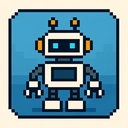
The pixel art software robot icon is a meticulously crafted digital emblem that masterfully intertwines three fundamental concepts—software, robot, and pixel art. This compact yet profound visual representation serves as more than just an interface element; it's a symbolic narrative of modern digital innovation, where the mechanical precision of robotics converges with the algorithmic complexity of software development and the nostalgic charm of retro digital aesthetics.
At its core, this icon embodies software. The robot is not merely a static figure but an active representation of code in motion. Its design features glowing circuit-like patterns that extend from its joints and chest—each line carefully crafted with the precision of a programming language syntax. These circuits resemble hexadecimal values or binary sequences that pulse subtly, suggesting real-time data processing. The robot's head houses a small, pixelated screen displaying animated code fragments (perhaps a snippet of Python or JavaScript), reinforcing the idea that this is not just any robot but one deeply embedded in software ecosystems. This visual metaphor communicates intelligence, logic, and digital functionality—hallmarks of modern software systems.
The robot component is rendered with an endearing yet futuristic aesthetic. Standing approximately 16×16 pixels—a hallmark of authentic pixel art—the robot’s form is composed entirely of distinct, blocky squares that maintain the integrity of the medium. Its body is segmented into geometric shapes: a sturdy square torso, cylindrical arms and legs, and a rounded head with expressive eyes made from two dark pixels set against a lighter background. These eyes aren’t just decorative; they flicker in sync with data flow patterns, giving the impression of active processing—like a digital mind at work. The robot’s hands are slightly raised as if holding invisible keys or manipulating code, suggesting interaction with software environments such as IDEs (Integrated Development Environments), debuggers, or version control systems.
The true genius of this icon lies in its adherence to pixel art principles. Every element is hand-placed within a limited color palette—typically 4 to 16 colors—to evoke the visual language of early video games and computer graphics from the 1980s and '90s. The artist has employed dithering techniques subtly to create gradients (such as on the robot’s chest plate) without breaking the pixelated aesthetic. Shadowing is achieved through strategic placement of darker pixels, lending depth while maintaining clarity at small sizes. This attention to detail ensures that even when scaled down to 16x16 pixels for mobile apps or desktop icons, the robot remains instantly recognizable and aesthetically coherent.
Moreover, the icon’s design subtly references digital culture. The robot wears a small, pixelated badge on its chest resembling an old-school floppy disk or a circuit board—symbolizing data storage and software architecture. Its back features tiny, pixel-perfect bolts and screws, hinting at its mechanical nature while also suggesting that it can be “disassembled” in the way software components are modularized. These details aren’t merely decorative; they serve as visual cues for users familiar with both retro computing and modern programming concepts.
Functionally, this icon is designed to represent a software tool or application—perhaps a code editor, automation assistant, or AI-powered development plugin. It appeals to both nostalgic developers who appreciate vintage aesthetics and younger programmers who value clarity and visual storytelling in UI/UX design. The robot’s friendly yet intelligent appearance makes it approachable for beginners learning to code, while its technical details satisfy advanced users looking for meaning behind the visuals.
From a symbolic perspective, the fusion of software and robot represents the evolution of artificial intelligence in development environments. The robot is not a replacement for human coders but rather a collaborative tool—an AI assistant that understands programming logic and helps write, debug, or optimize code. This duality reflects current trends in AI-driven software such as GitHub Copilot or Tabnine, where intelligent agents work alongside developers.
In conclusion, this pixel art software robot icon is far more than a visual placeholder. It is a richly layered symbol that encapsulates the soul of modern digital creation: the harmony between human creativity and machine intelligence, rendered through the deliberate craftsmanship of pixel art. Every square has a purpose, every color choice tells a story, and every design decision reinforces its identity as an icon deeply rooted in software, personified by a robot, and meticulously crafted using the timeless techniques of pixel art. It stands as a tribute to both the past of computing and the future of intelligent software development.
Create your own icon with our GoGPT AI prompt:
GoGPT