

Software Tree Pixel art Free icon download
Download all to grab every PNG variant.
```html
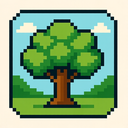
The icon is a meticulously crafted digital artwork that seamlessly fuses the concepts of software, nature, and retro aesthetics into a single, cohesive visual representation. At its heart stands an intricate pixel art tree – not a literal representation of any specific species, but rather a stylized embodiment of organic growth and digital complexity. This tree serves as both the central subject and symbolic metaphor for the interconnected nature of modern software systems.
Rendered in a precise 64x64 pixel grid (with optional scalable versions up to 128x128 pixels), every element of this icon is deliberately positioned within a grid-based framework – a hallmark of true pixel art. The tree's trunk, composed of carefully chosen dark brown and charcoal tones, forms a strong vertical axis that anchors the composition. Each pixel is placed with intention: the bark texture features subtle variations in shade to simulate depth and roughness, achieved through dithering patterns that evoke early 8-bit video game aesthetics.
Branches extend from the trunk in organic yet algorithmic patterns. They branch outward in fractal-like repetitions – a design choice that pays homage to recursive algorithms commonly found in software development. These branches are rendered using shades of forest green, moss green, and teal, creating visual contrast while maintaining harmony with the overall palette. Each branch terminates not with random twigs but with carefully positioned pixelated leaves shaped like binary code symbols (0s and 1s), subtly integrating the digital theme into nature's form.
What truly elevates this icon beyond a simple tree is how it represents software architecture through its visual language. The roots beneath the trunk are not merely decorative; they form a network of interconnected nodes, resembling a database schema or code dependency tree. These root elements appear as glowing cyan pixels arranged in clusters, pulsating slightly with a subtle animation when the icon is displayed interactively – mimicking data flow in real-time software systems.
The leaves themselves are not static. In the animated version of this icon (commonly used in digital interfaces), each leaf flickers independently like individual processes running on a computer. When viewed closely, some leaves contain miniature circuit board patterns, while others display tiny code snippets such as "function()", "return true;", or "import module". These micro-details are only visible at larger scales but reinforce the core theme: a living system born from digital logic.
Color palettes reflect both natural and technological elements. The dominant hues are derived from a vintage 8-bit color scheme – limited to 16 colors including deep blacks, vibrant reds, electric blues, and acid greens. This restraint enhances the pixel art authenticity while allowing strategic use of contrast for visual impact. A soft gradient effect is applied across the tree’s canopy using adjacent pixels to suggest light falling from above – a technique often used in retro game design to create depth without complex shaders.
The icon functions as a metaphor for software ecosystems: just as a tree grows through interconnected roots, branches, and leaves, so does complex software evolve through dependencies, modular components, and user interactions. The tree's central trunk represents the core application or operating system; each branch symbolizes different modules or features; individual leaves stand for end-user functions or services. This makes the icon not only visually appealing but conceptually rich for developers, designers, and users alike.
Designed primarily for use in software interfaces – such as development environments, file managers, project management tools, or digital asset libraries – this pixel art icon serves as a nostalgic yet forward-thinking emblem. It bridges the gap between the warmth of nature and the precision of code. Whether displayed on a game UI, a programming IDE sidebar, or within an interactive dashboard metaphor for system architecture, the icon remains instantly recognizable and meaningful.
In essence, this pixel art icon transcends its visual form to become a symbol of digital evolution – where natural growth patterns inspire software design principles. It celebrates the fusion of organic forms with artificial intelligence, reminding users that even the most complex code systems are built from simple elements, just as trees grow from single seeds through countless tiny decisions and connections.
Ultimately, this 64x64 pixel masterpiece exemplifies how pixel art can convey deep conceptual meaning. It’s not merely a decorative element but a thoughtful representation of software's relationship with nature: complex yet structured, artificial yet alive. In an era dominated by high-resolution graphics and abstract UIs, this icon stands as a tribute to craftsmanship, simplicity, and the enduring beauty of intentional design.
```Create your own icon with our GoGPT AI prompt:
GoGPT