

Space Credit card Digital glitch Free icon download
Download all to grab every PNG variant.
```html
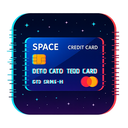
The icon presents a bold and imaginative synthesis of three seemingly unrelated concepts—Space, Credit Card, and Digital Glitch—crafted into a single visual narrative that speaks to the intersection of digital finance, interstellar exploration, and the fragility of technological systems. At first glance, it appears as an abstract piece of cyberpunk art; upon closer inspection, it reveals layers of meaning embedded in its form and color scheme.
The central element is a stylized credit card—rectangular with rounded corners—floating in the vastness of deep space. The card itself is rendered with metallic sheen and subtle reflective highlights, suggesting high-end digital currency or a premium crypto-token issued by an intergalactic financial consortium. The front of the card displays holographic symbols: a stylized constellation, possibly representing a galactic bank's logo, and encrypted data sequences that flicker subtly in binary code. These elements are not static—they exhibit slight motion blur, as if being transmitted through hyperspace.
The background is an infinite expanse of cosmic depth: nebulae swirl in pastel hues of violet, electric blue, and magenta. Stars pulse at irregular intervals—some blinking rapidly like error signals, others fading into blackness. The perspective suggests a zero-gravity environment where the card drifts weightlessly through a galaxy far beyond human reach. This setting reinforces the idea that traditional financial systems are no longer bound by terrestrial borders or physical infrastructure; instead, they exist in orbit around digital economies that span planetary systems.
But what truly defines this icon is the pervasive presence of Digital Glitch. Across the card and spilling into space, visual disturbances manifest as pixelation waves, chromatic aberrations, and fragmented data bursts. These glitches aren't random; they form deliberate patterns that resemble corrupted code or encrypted signals trying to break through. The glitch effect appears both on the surface of the credit card and in its surrounding space—like a network failure rippling outward from the core object.
Specifically, portions of the card's face seem to dissolve into static at irregular intervals. The magnetic stripe flickers with binary sequences that momentarily form words like “AUTHORIZATION FAILED” or “TRANSACTION TIMEOUT,” only to vanish as the glitch resets. The corners of the card warp slightly, as if data is being stretched beyond its intended format—like a digital artifact caught between two realities: the physical (the card) and the virtual (the encrypted data stream).
The color palette enhances this dichotomy: cool metallic silver and deep black dominate the credit card’s base, symbolizing trust, security, and permanence. However, against this stable foundation, electric cyan lines pulse erratically through the surface—representing unstable data transmission. These lines fracture into digital raindrops of scattered pixels that fall into space like stardust but carry error messages in miniature font sizes.
Moreover, embedded within the glitch patterns are faint silhouettes of human faces and hands—not clear or solid, but translucent and distorted—suggesting the fragile human element behind automated financial systems. They appear to be reaching toward the card from different directions, as if attempting to verify a transaction that is failing due to system-wide corruption. This layer adds emotional depth: despite the technological marvels of space-based banking, humanity remains vulnerable to digital breakdowns.
Even the stars in the background are affected by glitching. Some flicker out and reappear with different colors, as if caught in a loop of corrupted astronomical data. Others appear to be pixelated—resembling low-resolution images from ancient satellite feeds—implying that even our cosmic knowledge is imperfect and subject to error.
Functionally, this icon serves as a powerful metaphor: the promise of universal digital finance (symbolized by the credit card) reaching into the farthest reaches of space (the cosmos), yet always teetering on the edge of collapse due to systemic vulnerabilities (the digital glitch). It speaks to our current age—where financial independence is increasingly tied to technology that operates beyond our full comprehension, and where a single corrupted line of code can disrupt economies across continents—or even star systems.
In essence, this icon does more than represent three keywords. It weaves them into a cohesive story: the dream of interstellar commerce fueled by secure digital currency is breathtaking—but its reality is unstable, fragmented, and perpetually on the brink of failure. The beauty lies not in perfection, but in the tension between order and chaos—the card's sleek form battling against the infinite noise of digital entropy.
Ultimately, this icon stands as a visual manifesto for our digital future: elegant yet fragile, expansive yet unreliable. It challenges viewers to consider what happens when finance transcends Earth—and how much control we truly retain over systems that operate beyond human reach and understanding.
```Create your own icon with our GoGPT AI prompt:
GoGPT