

Space Drone Retro Free icon download
Download all to grab every PNG variant.
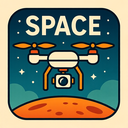
In the vast tapestry of digital iconography, few concepts blend the past and future as seamlessly as this meticulously crafted emblem—a retro-futuristic space drone icon that captures the essence of human imagination, technological aspiration, and vintage aesthetic. This design is not merely an image; it is a time-traveling artifact that fuses the nostalgic charm of mid-20th-century sci-fi with the boundless wonder of interstellar exploration. At its core lies a harmonious balance between three powerful themes: Space, Drone, and Retro. Together, they converge in a single, captivating symbol that speaks to both the pioneers of space travel and the dreamers who still gaze at the stars with childlike wonder.
The icon's primary inspiration lies in humanity’s enduring fascination with Space. The drone is not grounded on any planet—it hovers within a stylized, nebula-drenched cosmos. Its position near the center of the composition places it at the heart of an imaginary galactic journey. Behind it stretches a deep violet and indigo backdrop, streaked with wisps of pink and gold—evoking swirling galaxies, distant supernovae, and cosmic dust. Tiny stars are scattered like glitter across this infinite canvas, some twinkling subtly as if caught in a momentary animation when the icon is active.
What sets this space depiction apart is its deliberate absence of realism. There’s no detailed planetary surface or satellite orbit—instead, the focus remains on atmosphere and mood. The void isn't empty; it's alive with suggestion. Curved lines reminiscent of old-fashioned astrolabes and celestial charts crisscross the background, creating a sense of navigational mystery. These elements echo the early days of astronomy, when maps were drawn by hand based on observation rather than precise measurement—a hallmark of Retro design that adds narrative depth.
Central to the icon is the Drone, designed with a hybrid of mechanical precision and playful stylization. It resembles a mid-century flying saucer, but with subtle upgrades that suggest advanced technology—without sacrificing charm. The body is streamlined yet angular, constructed from brushed metal tones in silver and gunmetal gray. Its surface bears faint dents, scratches, and rivets—visual cues that hint at long journeys through space dust and micrometeorite impacts.
The drone features four rotating thrusters arranged symmetrically around its base. These are not sleek or aerodynamic like modern propulsion systems—they are bulbous, almost retro-futuristic in their shape, resembling the vacuum tubes of old radios or television sets. Each thruster emits a soft blue-white glow when active, simulating propulsion in zero gravity. The lighting effect is intentionally flickering and analog—like an old neon tube—further reinforcing its Retro identity.
At the front, a single "eye" lens glows faintly green—a symbolic sensor array that peers into the unknown. This eye isn’t digital; it’s rendered with a hand-drawn circuitry pattern inside, like the schematics you'd find in vintage science fiction comics from the 1950s. The drone also carries an antenna shaped like a retro-style TV aerial, curved and flaring outward at the tips—evoking both radio signals and early communication attempts with outer space.
The Retro quality of this icon is not a mere costume—it's an intentional design philosophy. Every line, color, and texture draws from the visual language of the 1950s and 60s, when science fiction was less about hard technology and more about dreams. The color palette leans heavily into pastel magenta, mustard yellow, sky blue, and electric orange—colors commonly used in vintage space posters by artists like Chesley Bonestell or Robert McCall.
The borders of the icon are slightly warped, with a subtle halftone pattern overlay that mimics old print techniques. This gives the image a tactile quality—as if it were once printed on paper, possibly tucked into an issue of Popular Science from 1963. The edges of the drone itself have a slight gradient that fades into soft blur, reminiscent of film grain or faded photographs.
The font used in any accompanying label—should the icon be part of a larger interface—is also inspired by retro typography. It resembles hand-painted signs from rocket launch sites, with blocky letters and bold outlines. If text were to appear around the icon, it would use uppercase letters with slight tilt and irregular spacing, as if typed on a mechanical typewriter.
Ultimately, this space drone icon is more than just a visual motif—it’s a metaphor. It represents humanity's unending drive to explore beyond what we know, wrapped in the warm embrace of nostalgia. The Retro styling reminds us that our dreams of space were born long before we could reach it—through comic books, pulp novels, and radio broadcasts. The Drone symbolizes our modern tools: autonomous machines sent to remote corners of the solar system to gather data, scout terrain, and send back messages from the void. And Space, of course, remains the ultimate frontier—both literal and symbolic.
This icon stands as a bridge between eras. It honors the pioneers who imagined space travel before it was possible—and celebrates today’s engineers who are making those dreams real, one autonomous flight at a time. In its compact design, it tells a story: of curiosity across centuries, of technology shaped by imagination, and of an eternal quest to understand our place in the universe.
Create your own icon with our GoGPT AI prompt:
GoGPT