

Space Globe Digital glitch Free icon download
Download all to grab every PNG variant.
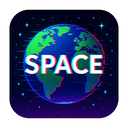
The icon in question is a masterful fusion of three distinct yet interconnected concepts—Space, Globe, and Digital Glitch. It represents a visual narrative that transcends mere design by embodying the evolution of human consciousness in an increasingly interconnected and technologically advanced world. At its core, this icon serves as a symbolic portal into the modern era: one where planetary unity intersects with cosmic exploration and digital transformation. The central element of the icon is a stylized, three-dimensional globe. However, this is no ordinary representation of Earth. Crafted from translucent layers of deep indigo and nebula-like violet hues, the globe appears to float within an infinite black expanse—evoking the vastness of space. Its surface is rendered with intricate topographical detail: continents subtly outlined in glowing silver threads, oceans shimmering with a cool bioluminescent blue. What distinguishes it from traditional globes is its dynamic nature—the globe rotates slowly and imperceptibly, as if caught in a silent cosmic ballet. But the true marvel lies not in its realism but in the subtle yet pervasive presence of digital glitch effects. Running across the surface of the globe like fractured veins are streaks of corrupted data—sparks of electric pink, magenta, and cyan that flicker erratically. These glitches do not distort or destroy; instead, they integrate harmoniously with the Earth’s imagery, creating a sense of digital metamorphosis. One moment, a continent appears intact; the next, its outline dissolves into fragmented pixels before reforming with slight variations—perhaps Africa's coastline shifts slightly toward an unexpected shape, or the Pacific Ocean pulses in rhythm with a hidden algorithmic pulse. These glitch effects are not random. They follow a deliberate pattern—a kind of visual code embedded within the icon’s DNA. At certain intervals, brief bursts of digital interference ripple outward from the poles, resembling electromagnetic waves. These bursts momentarily warp gravity-defying lines that connect key points on the globe: major cities, satellite orbits, or deep space research stations—each marked with miniature starbursts or data packets floating in zero-gravity fashion. The background is an immersive cosmic void, rendered with a depth that feels infinite. Stars are not uniformly distributed but appear in clusters resembling constellations that form cryptic symbols: perhaps the shape of a neural network, or a DNA helix curled into orbit. Some stars blink on and off rhythmically, mimicking digital signals—like Morse code from distant civilizations or data streams from quantum satellites. The overall aesthetic combines cyberpunk futurism with celestial serenity. The globe appears to be both physically present and digitally simulated—a paradox that captures the essence of modern existence: we are rooted in a physical planet while simultaneously existing in layered virtual realms. The digital glitch is not a flaw but an essential feature, signifying transformation, adaptability, and the constant evolution of our global identity. The icon's edges are framed with a subtle grid—faint lines resembling network architecture or quantum lattice patterns—that seem to stretch into the cosmos itself. These grids occasionally flicker in sync with the glitches on the globe’s surface, creating a visual feedback loop between Earth and space. The result is an icon that feels alive—constantly processing information, recalibrating its form, and communicating with unseen systems. Moreover, color plays a critical role in conveying meaning. The deep blues and purples of space contrast with the warm golds and greens of the Earth’s surface—symbolizing balance between nature and technology. Yet these colors are disrupted by harsh digital tones: jagged red lines that slice through landscapes, or sudden bursts of green code cascading across oceans like digital algae blooms. These intrusions suggest both danger and potential—warnings about technological overreach, but also visions of a future where humanity integrates seamlessly with AI, space travel, and planetary systems. Perhaps most intriguing is the icon’s implied motion. Though static in form when viewed on a screen, it evokes continuous movement: the rotation of Earth, the drift of glitch particles through space-time, and the subtle shimmering of data waves. This kinetic energy suggests that this icon is not just a symbol but an active interface—a portal into a larger digital ecosystem where humanity’s digital identity orbits around our physical home. In essence, this icon captures a profound truth: in the 21st century, we are no longer confined by geography or technology. Our planet is both our cradle and our cockpit for interstellar ambition. The globe represents unity—our shared home—while space symbolizes limitless possibility. And the digital glitch? It is the language of innovation, error, and rebirth—the very pulse of progress in a hyperconnected world. This icon does not merely depict a concept—it embodies it. It is a visual manifesto for an era where Earth’s fate is intertwined with artificial intelligence, space colonization efforts, and real-time global connectivity. The fusion of Space, Globe, and Digital Glitch creates more than an image; it becomes a philosophy—a reminder that our future lies in balancing the ancient wisdom of our planet with the boundless potential of digital evolution.
Create your own icon with our GoGPT AI prompt:
GoGPT