

Space Leaf Organic Free icon download
Download all to grab every PNG variant.
```html
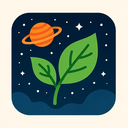
The icon embodies a profound visual metaphor representing the intricate relationship between the vastness of outer space, the delicate beauty of nature's most fundamental form—the leaf—and the inherent principles of organic design. This is not merely an emblem; it is a symbolic narrative that unfolds across cosmic and biological scales, suggesting unity between humanity’s quest to explore the universe and our intrinsic connection to living systems.
At its core, the icon presents a stylized leaf—its shape echoing the symmetry of natural forms found in countless species across Earth's ecosystems. The leaf is rendered with meticulous attention to organic detail: veins follow fractal-like patterns reminiscent of neural networks or river deltas, suggesting that life’s architecture is governed by universal mathematical principles. Yet, this leaf does not exist in isolation; it floats within a stylized representation of space—its form dissolving into the infinite darkness of the cosmos.
Space, depicted as a deep indigo void speckled with faint points of starlight, serves not as an empty backdrop but as an active participant in the icon’s narrative. The leaf appears to be composed of stardust—its edges gently glowing with a soft nebular luminescence that mirrors the way gas clouds emit light in distant galaxies. Microscopic particles swirl around and within the leaf structure, suggesting that life itself may have been seeded by cosmic events billions of years ago—the concept known as panspermia. In this interpretation, the leaf is both a product and a testament to space’s creative potential.
The organic aspect is not confined to the shape of the leaf alone but extends into every element of design. The contour lines follow flowing, irregular paths—never perfectly symmetrical but harmoniously balanced like those seen in living tissues. The color palette reflects a subtle gradient from deep cosmic violet at the base to vibrant emerald green at the apex, symbolizing evolution from primordial matter to flourishing life. This transition is not abrupt but fluid, with hues blending in natural transitions akin to those observed in bioluminescent organisms or sunsets on Earth.
Furthermore, the icon incorporates micro-organic details that reinforce its theme: tiny crystalline structures resembling biological cell formations are embedded within the leaf’s central vein. These elements evoke both cellular biology and mineral geology—two realms where organic patterns manifest in inorganic materials. This duality emphasizes how life is not separate from matter but emerges through it, shaped by the same laws that govern stars, planets, and galaxies.
Even the way light interacts with the icon reflects organic principles. Instead of harsh highlights or flat shadows, there are soft gradients and subtle tonal variations that mimic how sunlight filters through leaves in a forest canopy—or how starlight gently illuminates distant nebulae. This treatment creates depth without relying on artificial perspective, grounding the image in realism while maintaining its symbolic essence.
From a conceptual standpoint, the icon represents an ecological philosophy where space is not hostile to life but nurturing and generative. It challenges the notion of Earth as an isolated island in a vast, indifferent universe. Instead, it presents Earth—and all life—as part of a continuous cosmic process where energy flows from stars into planets, then into ecosystems through photosynthesis. The leaf becomes both recipient and transmitter of cosmic energy: absorbing sunlight (a form of starlight) to produce oxygen and sustain life—mirroring how stars create elements essential for biology.
The icon’s minimalist elegance belies its layered meaning. Its simplicity invites contemplation, encouraging viewers to reflect on their place within the universe. Is humanity just another leaf in a cosmic garden? Or are we, through science and art, capable of recognizing and honoring our connection to both the microcosm of living organisms and the macrocosm of space?
Designed for digital interfaces, branding in sustainable technology or environmental advocacy groups, this icon functions as a visual manifesto. It communicates that progress need not come at nature’s expense; instead, innovation can be rooted in organic principles—adaptive, resilient, and symbiotic. In a world increasingly dominated by artificial constructs and synthetic environments, the icon stands as a reminder: even our most advanced technologies should emulate the efficiency and beauty of natural systems.
In essence, this icon is more than a graphic element—it is an invitation to see ourselves not as conquerors of space or dominators of nature, but as participants in an ancient, ongoing story where every leaf carries the memory of stars, and every star holds the potential for life. Through the harmonious fusion of Space, Leaf and Organic design principles, it becomes a beacon—an emblem that reminds us: we are made from stardust and greenery alike.
```Create your own icon with our GoGPT AI prompt:
GoGPT