

Space Satellite Line art Free icon download
Download all to grab every PNG variant.
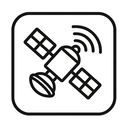
The icon in question is a masterclass in minimalist design, combining the ethereal vastness of space with the precision of technological advancement through the medium of line art. At its core, this icon captures not just an image, but a narrative—a silent story about human curiosity, exploration, and our enduring quest to reach beyond Earth’s atmosphere. The fusion of space, satellite, and line art is not merely thematic; it's structural to the icon's identity. Every stroke, every curve, every intentional gap in the line works in concert to convey depth, motion, and meaning—all within a monochromatic framework that emphasizes form over color.
The background of the icon is intentionally left empty or subtly suggested through negative space—this absence of color reinforces the concept of space. The vastness beyond Earth, infinite and silent, is not illustrated with gradients or textured overlays. Instead, it’s implied by the lack of filling in the surrounding area. This decision elevates the icon from a mere visual representation to an abstract symbol: space is not a place filled with matter but rather a canvas of possibility. The emptiness itself becomes part of the story, reminding viewers that outer space is not just empty but full of potential—of undiscovered worlds, cosmic phenomena, and human dreams.
Centered in this boundless void floats a sleek, geometric satellite—a symbol of human ingenuity and our ability to transcend planetary limits. The satellite is rendered with precise, continuous lines that form its primary structure: a central hexagonal or octagonal core with four elongated solar panels extending outward at symmetrical angles. The line art approach ensures that the satellite’s form is instantly recognizable yet deliberately abstracted—no intricate details of circuits or antennae are included, just the essential silhouette. This minimalism serves multiple purposes: it enhances scalability (the icon remains legible even at small sizes), maintains visual clarity across devices, and emphasizes conceptual purity over technical realism.
Each line in the satellite’s design is clean, unbroken, and consistent in weight—what designers call a “uniform stroke width”—a hallmark of classic line art. This uniformity creates rhythm and balance. The solar panels are not flat but subtly suggest depth through slight tapering at their ends, achieved purely by variation in line thickness and angle rather than shading or gradients. These lines form sharp, angular tips that catch the imagined light of distant stars—a poetic touch that implies orientation within space without relying on visual cues like sunlight direction or shadows.
Interestingly, the satellite’s movement is not illustrated through motion blur or trailing effects—common in more dynamic iconography—but rather through a single diagonal line extending from its base, curving slightly outward. This thin, elegant line functions as a symbolic trail of propulsion—a suggestion of orbiting or trajectory. It does not depict actual motion but rather the concept of movement across space. In this way, the icon transcends mere representation to become an emblem: it conveys speed, directionality, and purpose—all in a single fluid stroke.
The integration of line art with space is particularly effective because line art thrives on contrast and definition. In the infinite darkness of space, where there are no natural reference points or textures, the sharpness of lines becomes paramount. The satellite stands out not because it is bright or colorful, but because its defined edges create a focal point in an otherwise featureless expanse. This visual hierarchy underscores the idea that human-made objects in space—like satellites—are rare, deliberate intrusions into nature’s silence.
Moreover, the icon's design embraces symmetry and geometric harmony—two principles often associated with both celestial mechanics and technological engineering. The satellite’s symmetrical structure reflects orbital stability; its balanced form suggests precision, reliability, and control. These are values we associate with space exploration: rationality in the face of chaos, order in randomness. The clean lines mirror our desire to bring understanding to the unknown.
In sum, this icon is a profound synthesis of three powerful elements: the infinite mystery of space, the technological marvel of a satellite, and the artistic discipline of line art. It communicates complex ideas with minimal visual noise—proving that simplicity can be deeply expressive. Whether used in app interfaces, scientific illustrations, or educational materials, this icon doesn’t just depict a satellite in space—it embodies humanity’s enduring aspiration to explore, understand, and connect across the cosmos.
Create your own icon with our GoGPT AI prompt:
GoGPT