

Space Satellite Shadow effect Free icon download
Download all to grab every PNG variant.
```html
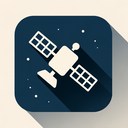
The icon embodies a sophisticated fusion of celestial wonder, technological advancement, and visual depth through the masterful integration of three essential elements: Space, Satellite, and Shadow effect. At first glance, the icon captures the vastness of outer space with its deep indigo background that mimics the infinite darkness between stars—a canvas where cosmic phenomena unfold in silence and mystery. This dark expanse is not merely decorative; it serves as a foundational stage upon which all other elements are presented with precision and symbolism.
Centered within this cosmic void floats a meticulously designed satellite, the primary subject of the icon. The satellite is rendered in crisp, geometric lines that suggest both modern engineering and futuristic design. It features a cylindrical main body with solar panels extending symmetrically from either side, positioned at precise 90-degree angles to create balance and dynamism. These solar panels are slightly angled to catch imaginary sunlight, adding realism and purpose to the satellite’s form. A small dish antenna extends from the top of the cylinder, symbolizing communication capabilities—essential for transmitting data across interstellar distances.
The satellite’s surface is textured with subtle metallic gradients that simulate reflective materials like polished aluminum or titanium alloy. These gradients shift subtly from silver at the edges to a slightly darker gray toward its core, suggesting both durability and the harsh conditions of space. Tiny details such as bolt heads, sensor arrays, and connection ports are etched along its exterior with precision, reinforcing the idea of a real-world technological marvel rather than a mere abstraction. Even in icon form—often reduced to just 24x24 or 64x64 pixels—these micro-details convey depth and authenticity.
What truly sets this icon apart is its masterful use of the shadow effect, transforming it from a flat symbol into a three-dimensional entity that appears to float in space. The shadow is not a simple dark blob but an intricately crafted gradient cast from the satellite at a deliberate angle—suggesting a light source positioned above and slightly to the left. This directional lighting enhances realism, creating volume and form that make the satellite appear tangible, as if it were suspended in zero gravity rather than rendered on a screen.
The shadow effect extends beyond mere aesthetics; it plays with perception and depth. The edges of the shadow are softly blurred at their outer edges, mimicking how light disperses in a vacuum where there is no atmosphere to scatter rays. This subtle softening reinforces the icon’s space setting, distinguishing it from terrestrial imagery where shadows are often sharper due to air particles and surface reflections. The length and direction of the shadow also suggest scale—elongated just enough to emphasize that this object is not merely floating but actively positioned in a three-dimensional environment.
Additionally, faint star-like specks are scattered throughout the background, spaced irregularly but strategically placed to evoke a sense of depth. These points of light vary in brightness and size: some are bold and luminous like distant stars; others are faint pinpricks, simulating faraway galaxies or nebulae. They do not interfere with the satellite’s prominence but instead enhance the context, making it clear that this is not just any satellite—it belongs to a grand cosmic system. Some of these light points are even partially obscured by the shadow of the satellite, creating an illusion of spatial layering and interplay between objects.
The integration of Space is more than thematic; it’s structural. Every design choice—from the color palette to the composition—supports the narrative that this icon exists in a realm beyond Earth. The absence of atmospheric distortion or terrestrial references (no clouds, no horizon lines) reinforces its extraterrestrial setting. The satellite itself becomes a symbol not just of human ingenuity but of our reach into the cosmos, our ambition to explore and understand what lies beyond.
Ultimately, this icon succeeds by balancing minimalism with complexity. In its small size, it conveys vastness: the infinite nature of space, the precision of satellite technology, and the emotional weight implied by shadow play. The shadow effect is not an afterthought—it’s central to meaning. It grounds the satellite in a physical reality within a metaphysical setting, reminding us that even in the void, objects have form, weight, and presence. Together, Space provides context; Satellite delivers purpose; and Shadow Effect adds dimensionality—transforming a simple icon into a miniature masterpiece of design philosophy.
```Create your own icon with our GoGPT AI prompt:
GoGPT