

Sports Piano Glassy – Free icon download
Download all to grab every PNG variant.
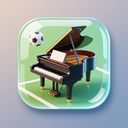
At the intersection of physical expression, artistic refinement, and optical elegance lies a uniquely compelling icon—crafted not merely as a visual motif but as a synthesis of three profound concepts: Sports, Piano, and Glassy. This icon transcends traditional design boundaries, embodying the dynamic tension between human movement, emotional resonance through music, and the ethereal quality of light refraction. It is not simply a representation—it is a narrative in visual form, capturing the essence of balance, rhythm, and clarity across domains that might otherwise seem unrelated.
The Sports aspect forms the foundation of this icon’s motion and vitality. At its core lies a stylized athlete in mid-action—perhaps leaping into a jump shot or executing a powerful sprint. The figure is not hyper-realistic, but instead abstracted into elegant, fluid lines that echo the grace found in high-level athletic performance. Every contour suggests momentum: the arc of a running stride, the tension in a bent knee during an explosive movement, or the poised balance of a gymnast mid-air. This element represents human potential—the drive to achieve excellence through physical discipline and perseverance. The athlete’s form is not static; it pulses with energy, suggesting continuous motion even in stillness. The dynamic lines mirror the rhythm found in sports—instinctive, rhythmic, and deeply intuitive—connecting the body to movement on both a literal and symbolic level.
Overlapping this physical vitality is the presence of the Piano. Not merely as a musical instrument, but as a symbol of expression, emotion, and structure. The piano appears not in its conventional form but rendered through an abstract geometric pattern—several intersecting strings resembling keys suspended mid-air in harmonic alignment. Each key is subtly illuminated, glowing with a soft tone that shifts from deep blue to silver-white depending on the "note" being played. These keys do not produce sound within the icon; instead, they serve as visual representations of musical harmony, echoing how sports and music both rely on rhythm, timing, and precision. The piano’s presence introduces emotional depth—its notes represent not just melodies but the internal cadence of human performance: a basketball player’s dribble mimics a steady beat; a sprinter’s stride mirrors the tempo of an upbeat refrain. In this way, sports become music in motion, and music becomes the silent soundtrack to every athletic pursuit.
Finally, the Glassy quality elevates this icon from mere illustration to a transcendent visual experience. The entire composition is rendered with a translucent effect—like light passing through stained glass or water reflecting sunlight. The athlete’s form, the piano keys, and even the background are subtly blurred and diffused, giving the impression of depth and luminosity. This glassy sheen does not merely suggest beauty—it reflects reality through multiple layers: it captures how athletes' movements are often seen in slow motion by fans; it mirrors how music resonates emotionally long after a performance ends; and it symbolizes clarity in perception—a quality essential to both sportsmanship and artistic integrity. The glassiness introduces a sense of timelessness, where action and stillness coexist, past and present blend seamlessly. It evokes the idea that excellence in sports is not only physical but also mental, emotional, and reflective—much like a well-played piano sonata.
What makes this icon so powerful is its ability to unify these diverse elements into a single coherent aesthetic. The athlete's motion inspires rhythm—the same rhythm found in piano notes. The keys suggest structure and intention, just as athletes plan their strategies before competition. And the glassy finish allows all of these components to exist in harmony without conflict—each element reflecting, refracting, and enhancing the others. This interplay creates a visual metaphor: that true excellence—whether in sports or music—is not isolated but relational. It is built through coordination between mind, body, and emotion.
Moreover, the icon functions as a cultural symbol. In contemporary society where physical fitness is celebrated and artistic expression is valued, this design serves as a bridge between two worlds. It speaks to young athletes who may also have an interest in music—those who see their discipline on the field mirrored in their practice of scales or chords. It reassures viewers that passion in one domain can enrich another. The glassy surface suggests that progress is not linear, but layered—like a piece of music unfolding over time, or a sports career with peaks and valleys.
From an artistic standpoint, the icon balances realism with abstraction. While the athlete and piano are recognizable motifs, their stylization ensures accessibility across age groups and backgrounds. The glassy finish provides visual interest without overwhelming detail—making it ideal for use in digital interfaces, educational tools, or wellness applications that aim to inspire balance between physical activity and mental well-being.
In conclusion, this icon is more than a design—it is a philosophy. It celebrates the synergy between Sports, Piano, and Glassy elements as pathways to holistic human growth. It reminds us that movement and melody, discipline and emotion, physical strength and mental clarity are not opposing forces but complementary dimensions of a fulfilling life. Whether viewed on a smartphone app promoting fitness with music integration or displayed in a gallery of modern art about human potential, this icon stands as a timeless tribute to the beautiful harmony found when passion, rhythm, and reflection come together.
Create your own icon with our GoGPT AI prompt:
GoGPT