

Sports Robot Pixel art – Free icon download
Download all to grab every PNG variant.
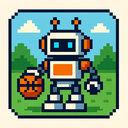
This icon masterfully fuses three distinct and influential design elements—Sports, Robot, and Pixel Art—into a dynamic, visually engaging representation that transcends traditional boundaries. The result is not just a simple image, but an immersive visual narrative that speaks to the intersection of human passion, artificial intelligence, and retro digital aesthetics. At its core, the icon presents a futuristic robot actively participating in a high-energy sports setting. This fusion does not rely on superficial combinations; instead, it creates a cohesive and meaningful experience where each element enhances and complements the others.
The Robot is central to this composition. Designed with exaggerated, expressive features common in classic pixel art, the robot stands tall with a segmented body composed of sharp geometric shapes. Its limbs are angular, each joint clearly defined by pixel lines that create a sense of mechanical strength and agility. The head features large, round eyes—each made up of simple 8x8 pixel blocks—that convey intense focus and determination. A small metallic mouth is slightly open, as if mid-speech or in the middle of a powerful roar during a game. The robot's armor is built from layered block patterns reminiscent of early video game designs, with subtle gradients achieved through alternating bright and dark pixels that suggest motion and depth despite the limited resolution.
The robot is not merely decorative—it functions as an active participant in the sports event. It appears to be mid-action, leaping over a field or sprinting down a track, its movements captured through dynamic pixel shifts. This gives the image a sense of motion and life that is essential to any authentic representation of sports activity.The Sports element is intricately woven into every aspect of the design. The background features simplified graphics of a stadium or track, composed entirely in pixelated blocks. The playing field itself is rendered in a grid-like fashion—each square representing a unit of space that mimics traditional pixel art layouts from games like Pac-Man or Super Mario. A ball is visible in the center, either being kicked or passed, made from vibrant red and white pixels to stand out against the neutral gray background. The robot’s motion is clearly tied to the sport: it might be running a sprint in a track event, leaping for a catch in a field game, or diving into action during a relay race. Even the crowd behind it is represented through pixelated silhouettes—standing in rows and waving hands, their exaggerated forms adding an emotional layer to the scene.
What sets this icon apart from generic robot-sports mashups is the depth of thematic integration. The robot doesn’t just "participate" in sports—it embodies them. Its actions are inspired by human passion and physicality, yet executed with a precision and clarity that only artificial intelligence could achieve. In this way, the robot becomes a symbol of innovation: a future where machines can not only simulate human behavior but also excel in competitive environments with unmatched consistency and strategy.
The pixel art style gives this icon both nostalgia and modernity. It evokes memories of early digital culture—8-bit gaming, arcade systems, and the rise of computer graphics in the 1980s and 1990s—while simultaneously presenting a fresh, imaginative vision for how technology can engage with traditional human interests like sports.Each pixel in this design is carefully chosen to convey not just form, but emotion. The robot’s limbs stretch forward as if accelerating, its pixels forming dynamic curves and angles that suggest speed. The background field pulses with subtle color variations—changing from green to blue during a rain delay or from white to yellow during high-energy moments—adding a sense of environment and time-based narrative. Even the lighting is stylized through pixel contrast: bright highlights on the robot's armor suggest it’s under the spotlight, while shadows in the background deepen into darker pixels, creating dimension without relying on complex shading techniques.
This icon serves not only as an aesthetic object but as a conceptual bridge between technology and human activity. In a world increasingly dominated by automation and artificial intelligence, this robot embodies the idea that machines can be deeply involved in areas traditionally associated with human passion—such as physical competition, teamwork, and achievement. It suggests a future where robots are not just tools but participants in sports culture, learning from humans while also pushing boundaries through speed, precision, and endurance.
Moreover, the use of Pixel Art adds a layer of cultural significance. Pixel art is more than just a visual style—it represents creativity within constraints. By using only basic shapes and limited color palettes (typically 16 to 256 colors), this icon demonstrates that powerful narratives and emotional resonance can still be achieved in minimal form. It speaks to the power of simplicity, where each pixel contributes meaningfully to the overall message: a machine, built from digital blocks, passionately engaging in human sports.
In conclusion, this icon is more than a mere visual design—it is a celebration of convergence. The synergy between Sports and Robot creates an exciting narrative of competition and innovation. The Pixel Art style ensures that this vision remains rooted in history while feeling fresh and forward-looking. Together, these three elements form a compelling portrait of the future: where technology doesn’t replace human passion, but amplifies it through creativity, energy, and digital imagination.
For designers, developers, or fans of retro aesthetics and futuristic themes alike, this icon stands as a powerful testament to what can be achieved when traditional elements are reimagined through the lens of innovation and artistry. It is not just a symbol—it is a statement: that robots can play sports, pixel art can inspire emotion, and technology can celebrate human values in new forms.
Create your own icon with our GoGPT AI prompt:
GoGPT