

Technology Smartphone Origami – Free icon download
Download all to grab every PNG variant.
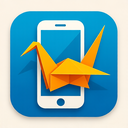
At the intersection of innovation, tradition, and human ingenuity lies a profoundly symbolic icon that masterfully fuses three powerful concepts: Technology, Smartphone, and Origami. This intricate visual representation is not merely a combination of elements but an embodiment of harmony between the digital world and ancient artistry. Designed with precision and intention, the icon serves as both an aesthetic masterpiece and a narrative tool—inviting viewers to reflect on how modern advancements can coexist with timeless cultural practices.
At its core, the icon depicts a smartphone seamlessly integrated into an origami crane. The smartphone is not simply placed upon or adjacent to the crane—it is folded into the structure itself, suggesting that technology has been embraced and transformed by traditional craftsmanship. The phone's sleek lines and modern curves are rendered with high fidelity, capturing its glossy surface, subtle edges, and glowing screen. However, instead of being static or detached from its surroundings, the smartphone is delicately folded along a crease that mirrors the precise folds of origami paper—each fold representing a moment of creation where digital innovation meets artistic discipline.
The smartphone in this icon is not just any device; it symbolizes connectivity, access to information, and human interaction in the digital age. Yet within its form lies a paradoxical transformation: while technology often appears cold and impersonal, here it is infused with warmth through the tactile nature of origami. The folds of paper bring a sense of handcrafted care—something that contrasts sharply with the automated, algorithm-driven aspects of modern technology. This duality highlights a critical theme: that even in our hyper-connected world, there remains value in patience, precision, and human touch.
Origami—the art of folding paper into intricate shapes—is not just an aesthetic choice in this icon; it is foundational to its meaning. Originating centuries ago in Japan as both a cultural practice and a spiritual expression, origami embodies balance, symmetry, and impermanence. In the context of the icon, these principles are mirrored within the smartphone’s structure. Just as an origami crane rises from flat paper with graceful motion and delicate precision, the smartphone emerges from its folded state—not merely as a tool but as a living extension of human creativity. Each fold represents a decision, a thought process, an act of design that parallels how software developers and engineers approach problem-solving.
Moreover, the crane itself serves as more than just a traditional symbol—it acts as an agent of transformation. In Japanese culture, origami cranes are associated with peace, hope, and perseverance. When this symbolic element is combined with a smartphone, it suggests that digital technology can be harnessed for positive social outcomes—such as improving education through mobile learning apps, enabling remote communication for global collaboration, or offering mental wellness tools via mindfulness-based smartphone applications. The crane thus becomes a metaphor: not just of flight and freedom, but of human potential when technology is guided by compassion and cultural wisdom.
From a technological standpoint, the icon demonstrates how contemporary design thinking can incorporate sustainable principles. Paper is biodegradable, renewable, and environmentally responsible—qualities that are increasingly important in an era where digital consumption often leads to electronic waste. By using origami as a base for the smartphone representation, the icon subtly promotes eco-conscious technology design. It suggests that innovation does not have to come at the cost of sustainability; rather, it can be rooted in respect for nature and traditional methods.
The interplay between structure and form is another key aspect. The smartphone’s screen is visible but partially folded into the crane's wing, suggesting that digital content—whether information, images, or videos—is not consumed passively but is actively shaped by the user through creative folding. This reflects a deeper understanding of user experience: technology should be intuitive, adaptable, and responsive to human behavior—just as an origami model responds to the hands that fold it.
Additionally, this icon serves as a bridge between generations. Younger audiences may instantly recognize the smartphone as a symbol of modern life, while older generations might appreciate the cultural significance of origami. By merging these two worlds, the icon becomes a unifying visual language—one that transcends age, background, and technological proficiency. It speaks to universal values such as creativity, resilience, and connection.
In conclusion, this icon is far more than a simple illustration; it is a philosophical statement about the future of technology. It proposes that progress does not require the abandonment of tradition—it can thrive through thoughtful integration. The fusion of Technology and Smartphone with Origami creates a vision where innovation is not cold or detached but deeply human, intentional, and respectful of cultural roots. In this way, the icon becomes a powerful emblem for responsible innovation—an invitation to build digital tools that are as beautiful and meaningful as they are functional.
Ultimately, this design invites contemplation: how can we ensure that our technological advances serve humanity rather than replace it? How can we preserve the art of handcraft in an age dominated by automation? And what role does creativity play in shaping a future where technology is not only efficient but also emotionally resonant?
Through its elegant fusion of Technology, Smartphone, and Origami, this icon answers those questions—not with data or statistics—but with a single, delicate fold. A fold that suggests transformation. A fold that speaks to hope. And a fold that reminds us: even in the age of artificial intelligence and infinite connectivity, the human hand—folded gently over paper—remains one of our most powerful tools for building a better future.
Create your own icon with our GoGPT AI prompt:
GoGPT