

Transportation Battery 3D isometric – Free icon download
Download all to grab every PNG variant.
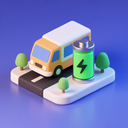
This meticulously designed 3D isometric icon seamlessly fuses the dynamic elements of Transportation, Battery, and advanced 3D isometric design principles into a visually compelling and functionally intuitive representation. The icon serves as both an aesthetic statement and a practical visual language tool, suitable for digital interfaces such as vehicle dashboards, smart device apps, mobile navigation systems, electric vehicle management software, or urban mobility platforms.
The foundation of this icon lies in its 3D isometric design, a visualization technique that presents three-dimensional objects from an angled perspective—typically at 30-degree angles—providing depth and realism without the complexity of full 3D rendering. This approach allows users to instantly perceive spatial relationships, making it ideal for complex systems involving movement, energy flow, and interconnected components. Each element within the icon is constructed using clean lines, consistent proportions, and layered geometric shapes that give a sense of physicality and structure. The use of isometric projection enables viewers to understand how different parts—such as vehicle components or power sources—relate to one another in space, enhancing clarity and user comprehension.
At the core of the icon lies the Transportation aspect. Rather than depicting a simple car or bus, this icon presents a modern electric vehicle (EV) in mid-motion, rendered with architectural precision. The vehicle is composed of symmetrical geometric forms: a streamlined hood, rectangular body panels, and angular wheel assemblies arranged at 120-degree angles to reflect the isometric perspective. The wheels are not merely circular; they feature subtle tread patterns and rotating motion indicators that suggest movement in real time. A dynamic path or trajectory line extends from the front of the vehicle into the background, symbolizing forward motion—indicating active transport, route progression, or navigation functions.
Integrating with this transportation element is a Battery system embedded within the vehicle's underbody structure. The battery is not presented as a static component but as an evolving energy source that interacts dynamically with the vehicle's operation. It appears as a modular, hexagonal energy cell block positioned beneath the chassis, with visible voltage indicators—represented through gradient color transitions—from green (full charge) to red (low or empty). These colors are not only symbolic but also serve functional purposes: they provide immediate visual feedback on energy status within user-facing applications. The battery module is designed with 3D depth, featuring a slight embossing effect and a translucent casing that allows the internal structure—such as copper wiring and flow channels—to be visible, reinforcing the technical authenticity of the design.
What sets this icon apart is its intelligent integration of Transportation and Battery systems. The battery’s charge level directly influences how far the vehicle can travel—the visual representation evolves based on energy availability. For instance, when the battery is at 80% charge, a glowing blue pulse radiates from the center of the battery module, extending subtly toward the wheels to indicate extended range. As charge drops below 20%, this pulse dims and turns amber, while a warning icon (a small exclamation mark or low-bar symbol) appears in proximity to the vehicle’s rear. This dynamic relationship creates a narrative within the icon: it tells a story of energy consumption during transit, emphasizing efficiency and sustainability—key themes in modern transportation technology.
Additionally, the 3D isometric style allows for multiple interpretive layers. The same icon can be adapted for different contexts—such as a public transit system where battery power represents energy stored in electric buses or trams; or in personal mobility devices like e-bikes or scooters where battery life dictates usage duration. The modular nature of the 3D isometric framework makes it scalable and reusable across various industries, from automotive to urban planning to renewable energy management.
The use of consistent line weights, flat colors with subtle shadows, and a minimalist approach ensures that the icon remains legible on small screens—essential for mobile devices and dashboards where space is limited. At the same time, the depth created through isometric angles gives users a tangible sense of scale and physical presence. This balance between simplicity and detail makes it highly effective in user interface (UI) design, allowing developers to embed intuitive feedback without overwhelming the user.
From a technical standpoint, this icon was developed with scalability in mind. It can be resized without losing its structural integrity or clarity, making it compatible with both web-based applications and embedded software. Its vector format supports infinite resolution, ensuring crispness across high-DPI displays and responsive screens.
Furthermore, the combination of Transportation and Battery within a 3D isometric framework reflects current technological trends in sustainable mobility. As cities evolve toward electric transportation solutions, the ability to visualize energy flow in real time becomes critical. This icon serves as a powerful metaphor for the future: where movement and power are not separate concepts but deeply interconnected systems.
Through its thoughtful design, this 3D isometric icon does more than represent a vehicle or energy source—it communicates intelligence, interactivity, and balance. It embodies the synergy between innovation in transportation technology and sustainable energy practices. Whether used in an app for route planning, a dashboard monitoring EV performance, or as part of a public transit information system, it provides clarity, engagement, and emotional resonance through its visual storytelling.
Ultimately, this icon stands as a modern exemplar of how design can merge functionality with aesthetics—transforming abstract concepts like energy consumption and vehicle motion into tangible, accessible experiences. It is not just an image; it is a dynamic symbol of progress in the evolving landscape of smart transportation and sustainable urban living.
Create your own icon with our GoGPT AI prompt:
GoGPT