

Transportation Bridge 3D isometric – Free icon download
Download all to grab every PNG variant.
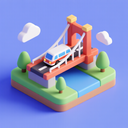
Icon Description: A 3D Isometric Bridge in a Transportation Context
This detailed and visually engaging icon represents a sophisticated fusion of modern transportation infrastructure and advanced design principles, centered around the powerful concept of a bridge. The icon is crafted using the 3D isometric perspective, which provides an immersive, realistic, and spatially accurate representation that mimics real-world depth and structure. This artistic choice elevates the icon beyond a flat or two-dimensional image, offering viewers a three-dimensional sense of scale, balance, and architectural complexity—key elements essential in understanding modern transportation systems.
At its core, the icon depicts a medium-sized bridge that spans across a valley or river with precision and clarity. The structure is composed of interlocking beams and support pillars arranged in an angular, symmetrical layout characteristic of 3D isometric design. Each element—whether it's the curved arches, vertical piers, or horizontal deck panels—is rendered with careful attention to geometric consistency. The use of isometric projection ensures that all three axes (x, y, z) are visible at a consistent angle (typically 30 degrees), allowing for an unobstructed view of the bridge’s structure from multiple perspectives simultaneously. This visual technique not only enhances aesthetic appeal but also conveys functionality and engineering stability.
Transportation is a central theme throughout this icon. The bridge is not merely a static structure; it serves as a dynamic artery connecting two landmasses, enabling the movement of vehicles, pedestrians, and even goods across otherwise impassable terrain. The deck of the bridge features realistic representations of lanes—two distinct lanes in each direction—suggesting a modern highway or urban roadway system. These lanes are clearly delineated using subtle lines and textures to emphasize traffic flow and capacity. In addition to vehicular movement, the icon subtly incorporates pedestrian pathways on either side, indicated by dashed white lines or stepping stones, highlighting its role in multimodal transportation networks.
From a design standpoint, this 3D isometric bridge reflects contemporary engineering advancements. The supports are not simplistic pillars but include tapered columns with layered textures that suggest reinforced concrete or steel construction. Some elements show visible joints and connections where beams meet, emphasizing structural integrity and modular design principles often found in modern infrastructure. The use of shading gradients—lighter tones for the top surfaces and darker shades for the shadowed edges—adds depth and realism, making it appear as though the bridge is part of a living, active transportation ecosystem.
The icon also reflects sustainability considerations within transportation planning. For instance, the bridge features eco-friendly materials such as green-colored railings or subtle vegetation patterns along its edges, symbolizing environmental integration. The overall form suggests minimal disruption to surrounding ecosystems—such as riverbanks or forests—indicating a design philosophy that balances human mobility with ecological preservation. This alignment with green transportation ideals makes the icon relevant in discussions about future urban development and climate-conscious infrastructure.
Furthermore, the 3D isometric style allows for scalability and versatility across different platforms and applications. Whether displayed on a digital dashboard, an urban planning app, a navigation system, or a mobile interface for public transit users, this icon can be easily resized without losing clarity or visual integrity. Its geometric precision ensures that it remains instantly recognizable even at smaller sizes—making it ideal for use in icons within apps or websites related to transportation logistics.
Another significant aspect of the icon is its symbolic value. It serves as a visual metaphor for connectivity and progress—core principles in transportation systems worldwide. The bridge represents not just physical movement but also social, economic, and cultural links between communities. By using the 3D isometric format, the icon conveys a sense of forward motion, stability, and innovation—qualities that are essential in modern transportation planning.
Technically produced with vector-based design tools such as Adobe Illustrator or Figma, the icon maintains high resolution and smooth edges even when zoomed in. The 3D isometric rendering is achieved through carefully calculated angles and layering techniques that create a realistic sense of depth without distortion. This fidelity ensures that every detail—such as rivets on support beams, road markings, or signage—is accurately represented while maintaining visual harmony.
The inclusion of subtle directional cues—such as arrows indicating flow of traffic or wind patterns affecting the bridge’s structure—adds another layer of interactivity and context. These elements encourage users to interpret not just what the bridge is, but how it functions within a larger transportation network. Such details are particularly valuable in educational materials, urban planning presentations, or public awareness campaigns focused on infrastructure.
In conclusion, this 3D isometric bridge icon stands as a compelling and multifaceted representation of modern transportation innovation. By integrating the essential elements of transportation, which emphasizes connectivity and mobility; bridge, which highlights structural engineering and inter-land connections; and the powerful visual language of 3D isometric design, which delivers depth, clarity, and realism—this icon becomes both a practical tool for communication and a visually striking symbol of progress in infrastructure development. It serves as an accessible yet sophisticated visual aid that resonates across diverse audiences—from engineers and city planners to the general public seeking to understand how modern transportation systems work.
Whether used in app interfaces, educational content, or geographic information systems (GIS), this icon provides a reliable and aesthetically balanced representation of a critical component in urban mobility. Its design embodies the harmony between form, function, and forward-thinking planning—making it not just an artistic creation but a meaningful piece of visual communication in today’s transportation-driven world.
Create your own icon with our GoGPT AI prompt:
GoGPT