

Transportation Key Origami – Free icon download
Download all to grab every PNG variant.
In the ever-evolving landscape of modern design and symbolic representation, few icons encapsulate a blend of functionality, accessibility, and artistry as powerfully as the one that fuses Transportation, Key, and Origami. This intricate yet elegant icon transcends mere visual aesthetics; it serves as a profound metaphor for human movement, access, and creative transformation. Designed with deep intentionality, the icon presents a harmonious convergence of three seemingly distinct concepts—each carrying its own cultural, practical, and philosophical weight—into a single dynamic image that speaks to both the tangible world of mobility and the intangible realm of innovation.
At its core lies Transportation, which is not merely represented as a vehicle or route but as an embodied journey. The icon features a stylized, flowing pathway composed of interlocking geometric shapes resembling train tracks, roads, or air routes—all rendered in soft gradients to suggest motion and direction. These lines curve and converge at the center, symbolizing not just physical movement but also the flow of ideas, people, and goods across time and space. The transportation element is subtly animated through subtle motion lines that appear like ripples or waves emanating from a central point, reflecting how modern systems—such as public transit networks or digital platforms—constantly evolve to meet human needs. This dynamic movement suggests connectivity, efficiency, and the continuous exchange of resources essential to societal progress.
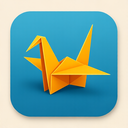
Embedded within this transportation network is a Key, not just as a literal object but as a symbol of access, opportunity, and empowerment. The key appears in the form of an elegant origami crane—its structure meticulously folded to maintain balance and symmetry. This folding technique gives the key its unique character: it is not bulky or mechanical, but delicate and artistic. The key’s shape mirrors that of a traditional paper crane—feathered edges, a curved spine, and a pointed tip—yet it functions as both an unlocker and a bridge. It sits at the intersection of the transportation network, subtly glowing with soft light to indicate activation. In this context, the key represents access to new routes, knowledge systems, or innovative services that might otherwise be locked behind barriers—whether financial, technological, or cultural.
What sets this icon apart is its integration of Origami, a Japanese art form rooted in precision, mindfulness, and transformation. The origami aspect is not merely decorative; it forms the very foundation of how the key and transportation systems interact. The entire structure of the icon is built upon principles of folding—each line and curve follows an origami-inspired pattern where flat surfaces are transformed into three-dimensional structures through careful creasing and layering. For instance, the transportation path appears as a folded paper sheet that has been unfolded to reveal a complex network beneath. When viewed from different angles or under specific lighting, the layers shift subtly, revealing hidden elements like hidden gates or alternate routes—much like how origami can conceal complexity within simplicity.
The interplay between these three components creates a layered narrative. The transportation network is not static; it responds to the presence of the key. When the key is "activated" by interaction—such as touching, clicking, or placing a hand over it—the lines of movement shift and expand dynamically, unlocking new routes or pathways that were previously inaccessible. This activation reflects real-world scenarios where access to transportation (e.g., ride-sharing apps, public transit passes) requires authentication—just as the origami key functions. The origami design ensures that this activation is not abrupt but gentle and intuitive, reflecting a human-centered approach to technology and mobility.
Moreover, the icon speaks to themes of sustainability and cultural heritage. Origami has long been associated with peace, harmony, and environmental consciousness—values that align with modern transportation goals such as reducing carbon emissions and promoting alternative modes of travel. The paper-like texture of the key subtly suggests recyclability and minimalism in design, reinforcing a vision where transportation is not only efficient but also respectful of natural resources. In this way, the icon becomes a visual manifesto for eco-conscious mobility solutions that are accessible to all.
From a psychological perspective, the combination of these elements evokes trust and openness. The key provides security and control, while origami brings warmth and creativity—factors essential in building user confidence when engaging with new transportation services. People are more likely to adopt digital or shared mobility tools when they feel empowered by accessible design. This icon visually communicates that such tools are not only functional but also thoughtful, designed with care for human emotions and experiences.
Additionally, the use of origami allows for scalability across different platforms—mobile apps, websites, smart city interfaces—and maintains aesthetic consistency regardless of screen size. Its simplicity in form belies its depth of meaning. Even when viewed in monochrome or low-resolution formats, the core elements remain recognizable: movement flows through a network, a delicate key unlocks it, and the artistry of origami ensures that every interaction feels intentional.
Ultimately, this icon stands as a powerful symbol for the future of transportation—where access is democratized, mobility is intuitive, and innovation is grounded in tradition. It does not merely depict movement or a tool; it embodies a philosophy: that progress should be accessible, sustainable, and crafted with care. Through the fusion of Transportation, Key, and Origami, the icon transcends its literal form to become a beacon of connectivity, empowerment, and creative potential in an increasingly complex world.
In sum, this is not just an icon—it is a story told through lines, folds, and motion. It invites users to imagine new possibilities where every journey begins with a single fold—an open key—and leads to infinite destinations made possible by thoughtful design.
Create your own icon with our GoGPT AI prompt:
GoGPT