

Transportation Robot 3D isometric – Free icon download
Download all to grab every PNG variant.
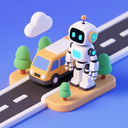
In today's rapidly evolving technological landscape, the convergence of intelligent machines and sustainable mobility has led to innovative design concepts that blend functionality with futuristic aesthetics. One such concept is a meticulously crafted 3D isometric icon that seamlessly integrates the themes of Transportation, Robot, and advanced visual representation through a 3D isometric style. This icon serves not only as a visual symbol but also as an emblem of the future of autonomous, efficient, and intelligent transport systems. Designed with precision and clarity, it encapsulates the essence of next-generation mobility powered by robotics.
The central figure in this 3D isometric icon is a sleek, humanoid robot designed to represent a self-driving or autonomous transportation unit. Unlike traditional depictions of robots confined to industrial or laboratory environments, this robot has been reimagined as a mobile agent operating within urban and intercity transport networks. Its form reflects both mechanical durability and modern elegance—rounded edges, smooth surfaces, and minimalist detailing give it a sense of fluidity while maintaining an unmistakable technological identity. The robot's body is composed of modular sections: the base supports a centralized processor unit, while upper limbs function as articulated arms capable of scanning environments or interacting with digital interfaces.
The 3D isometric perspective plays a pivotal role in this icon’s effectiveness. Instead of relying on flat two-dimensional representations, the design uses angular planes and depth cues to project a three-dimensional feel from a single, symmetrical view—typically set at 30 degrees from the horizontal plane. This visual technique allows viewers to perceive spatial relationships between components such as wheels, sensors, chassis, and internal structures without distortion or flattening. Each surface of the robot is rendered with subtle shading and gradient transitions that simulate light reflection, giving a realistic impression of form and material. The isometric layout ensures clarity in both detail and structure, making it ideal for use in digital interfaces where space is limited but information density must be high.
From a Transportation standpoint, the icon communicates functionality beyond mere movement. The robot is shown mid-motion, with wheels rotating smoothly beneath a low-profile chassis. These wheels are not standard rubber tires but feature smart material compositions—perhaps resembling hybrid polymers or magnetic drive systems—that allow for adaptive terrain response and silent operation. Integrated into the lower frame are sensor arrays that project outward like a network of small, glowing nodes, symbolizing real-time data collection and environmental awareness. This detail emphasizes the robot's role as an intelligent transport node capable of navigating complex urban environments with precision.
The robot’s upper body features a transparent display panel—likely resembling a holographic interface—that shows dynamic route maps, traffic updates, passenger loads, or energy consumption metrics. This digital interface underscores the integration between robotics and smart transportation systems. In essence, this robot is not just a vehicle; it's an autonomous agent equipped with AI-driven decision-making capabilities to optimize routes, avoid congestion, and adapt to changing conditions in real time.
What makes this icon particularly compelling is its ability to convey multiple layers of meaning at once. The 3D isometric style ensures that the design remains accessible across various platforms—mobile apps, dashboard interfaces, navigation tools, or urban planning software—without losing visual fidelity. Because it operates within a standardized visual language (isometric), it can be easily scaled and reused in different contexts without distortion. The clarity of depth and proportion makes it instantly recognizable even when displayed at small sizes or on low-resolution screens.
Moreover, the combination of Robot and Transportation suggests a shift from human-centric to machine-centric mobility. In cities where space is limited, energy efficiency is critical, and environmental impact must be minimized, such robotic transport units offer scalable solutions for public transit. This icon can represent everything from autonomous shuttle buses to delivery drones or personal mobility pods—each serving a different role in the future of urban logistics. The robot’s design encourages viewers to think beyond conventional vehicles and consider how intelligent machines could reduce traffic, cut emissions, and improve accessibility.
From a design standpoint, the use of 3D isometric rendering also allows for dynamic interaction. While static icons are common in UIs, this icon can be adapted into interactive elements where users hover over it to see animated versions of its movement or sensor functions. For instance, on a smart city dashboard, hovering over the robot might reveal an expanded view showing traffic flow patterns or energy usage statistics—all powered by the same underlying 3D model. This interactivity enhances user engagement and provides a deeper understanding of how robotics are transforming transportation.
Additionally, the icon's aesthetic appeals to both technical professionals and general audiences. Its clean lines, geometric precision, and futuristic appearance make it suitable for branding initiatives in tech startups, government smart city projects, or public transit agencies seeking to modernize their image. It strikes a balance between scientific accuracy and visual appeal—showing realistic mechanics without sacrificing artistic interpretation.
Finally, the integration of these three core elements—Transportation, Robot, and 3D isometric—creates a powerful symbol of innovation. In a world increasingly defined by automation and smart infrastructure, this icon stands as both a visual metaphor and a practical design tool. It represents the convergence of engineering, artificial intelligence, and urban planning in the pursuit of sustainable mobility solutions. By combining technical detail with accessible aesthetics through the 3D isometric format, it bridges the gap between science fiction and real-world implementation.
In conclusion, this 3D isometric robot icon is more than just a graphical element—it’s a conceptual gateway into the future of transportation. It embodies intelligent design principles, highlights technological advancement in mobility systems, and communicates complex ideas with clarity and visual impact. Whether used in product design, urban planning presentations, or digital interfaces for smart cities, this icon serves as a clear and compelling representation of how robots are redefining how we move through the world.
Create your own icon with our GoGPT AI prompt:
GoGPT