

Travel Bicycle 3D isometric – Free icon download
Download all to grab every PNG variant.
At the heart of modern visual communication lies a growing demand for intuitive, engaging, and contextually rich icons that reflect both function and emotion. One such powerful icon concept combines three key thematic elements—Travel, Bicycle, and 3D isometric—to create a visually striking, meaningful representation of exploration, movement, and urban interconnectivity. This icon transcends simple illustration by merging functional design with narrative depth, offering users not just a visual cue but an immersive experience that speaks to the spirit of adventure.
The foundation of this icon is built upon the 3D isometric rendering technique, which provides a unique perspective by presenting objects from three dimensions simultaneously—top, front, and side—at consistent angles. This method allows for depth perception without distortion and fosters a sense of realism within a flat design space. In this specific icon, the 3D isometric framework creates an illusion of spatial movement: the viewer perceives a dynamic journey unfolding in real time across cityscapes, open roads, and natural landscapes. The isometric projection doesn't just depict a static scene; it simulates motion—bicycles rolling forward, paths curving into distant horizons, and destinations emerging like milestones on the road.
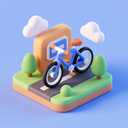
Within this 3D isometric environment, the Bicycle serves as both central subject and symbolic carrier of freedom. The bicycle is rendered with a detailed yet minimalist approach—its frame is sleek and angular, with a polished steel texture that reflects light realistically in the isometric view. Tires are depicted as slightly elongated ellipses, suggesting motion and interaction with the terrain. The handlebars are angled to suggest balance and forward momentum, while the front wheel appears slightly tilted to emphasize movement in a direction away from the viewer. This design choice not only highlights functionality but also evokes a sense of human agency—the rider is not just transporting themselves; they are navigating their path with intention and purpose.
Crucially, this bicycle is embedded within a broader Travel context. The icon extends beyond the bicycle itself to suggest destinations, routes, and transitions. In the 3D isometric layout, a winding road emerges from behind the bicycle’s back wheel—curving gently toward distant mountains or city gates. These roads are rendered with depth using parallel lines and gradients that simulate perspective, creating an illusion of distance and progression. At various points along this path, small landmarks appear: a quaint village with rooftops forming a cluster, a bridge arching over a river, or even a sunrise glinting on the horizon. These elements signal that travel is not merely physical—it is experiential, emotional, and cyclical.
Travel in this icon is portrayed as fluid and open-ended. Unlike traditional icons where destinations are fixed or rigid (e.g., a destination pin), the 3D isometric design allows for multiple possibilities. The path continues beyond the visible edge of the image, suggesting endless routes that can be taken depending on personal choice or environmental conditions. This aligns with modern values of sustainability and exploration—where travel is not about reaching a point, but about engaging with places, cultures, and environments in meaningful ways.
Moreover, the integration of 3D isometric design elevates the icon’s versatility across digital platforms. Whether displayed on a smartphone app for bike-sharing services, an urban planning dashboard showing commuting patterns, or a travel website highlighting eco-friendly routes, the icon maintains clarity and visual impact. Its three-dimensional form ensures that it stands out in crowded interfaces without relying on color or animation—offering immediate recognition even in low-light conditions or small screen spaces.
From a design standpoint, the use of isometric geometry allows for efficient spatial composition. The bicycle occupies a central position, with surrounding elements carefully arranged to maintain balance and depth. Light gradients are subtly applied—highlighting the bicycle’s frame in warm tones (like golden yellow) and casting soft shadows on terrain below, reinforcing the sense of movement through light and shadow dynamics. This attention to subtle visual cues enhances realism while remaining accessible to a broad audience, including younger users who are familiar with isometric games or app interfaces.
The emotional resonance of this icon lies in its ability to evoke feelings of independence, discovery, and connection. A bicycle represents accessibility—no need for cars or flights, just the rider and their personal journey. The 3D isometric view amplifies this sentiment by creating a sense of immersion: the viewer feels as though they are riding alongside the cyclist, seeing cities unfold from a unique vantage point. Travel becomes participatory rather than passive.
Additionally, this icon supports sustainability narratives. In an era where environmental concerns dominate public discourse, the bicycle symbolizes clean transportation—zero emissions, low carbon footprint—and is often promoted in eco-conscious campaigns. By embedding this message within a visually compelling 3D isometric format, the icon becomes a tool for education and advocacy.
In summary, this Travel-focused icon with a central Bicycle and crafted using advanced 3D isometric design principles creates more than just an image—it forms a narrative of movement, freedom, and connection. It balances technical precision with emotional appeal, making it ideal for use in applications ranging from navigation tools to lifestyle marketing. With its depth, clarity, and symbolic richness, this icon stands as a modern embodiment of how design can inspire action and foster a deeper relationship between people and places.
Create your own icon with our GoGPT AI prompt:
GoGPT