

Weather Bridge Asymmetrical Free icon download
Download all to grab every PNG variant.
```html
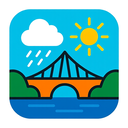
The icon in question is a masterful synthesis of three seemingly disparate concepts—Weather, Bridge, and Asymmetry—crafted into a single, deeply evocative visual symbol. At first glance, it appears as an abstract composition: a central structure that defies traditional symmetry and seems to hover between two distinct realms. The primary element is the bridge, but not an ordinary one. This is no rigid architectural construct of balanced beams and mirrored supports; instead, it embodies motion, imbalance, and emotional resonance. The bridge emerges from a turbulent sky on its left side—an area dense with swirling clouds of varying opacity—gradually descending toward a calm, sunlit landscape on the right. Its form is intentionally asymmetrical, with one half significantly longer and more intricately detailed than the other, suggesting imbalance, transition, or even psychological tension.
The bridge itself is rendered in a fractured style—its supports are uneven in height and thickness. On the left side, where it emerges from stormy clouds, the structure is jagged: steel girders twist at sharp angles like lightning bolts frozen mid-strike. These elements suggest instability and volatility. The right side, however, is smooth and elegantly curved—arched beams that gently arc toward a flat expanse of land bathed in golden sunlight. This deliberate imbalance creates visual tension, drawing the viewer’s eye across the icon not in a straight line but along an emotional journey—one from chaos to calm.
The integration of weather is profound and multifaceted. The left side is dominated by stormy atmospheric conditions: thick cumulonimbus clouds swirl with dynamic energy, rendered in deep grays and bruised purples. Rain streaks fall diagonally across the upper portion, but they don’t reach the bridge—instead, they dissolve into vapor just before impact, suggesting a moment of hesitation or transformation. Lightning bolts flicker at irregular intervals within the cloud mass—not symmetrically placed but rather scattered in unpredictable clusters. This randomness reinforces both the unpredictability of weather and the icon’s overall asymmetry.
As the bridge extends toward the right, weather conditions shift seamlessly into serenity. The clouds thin out and become wispy cirrus strands, painted in soft lavender and pale gold. A radiant sun peeks through from behind a translucent layer of haze, casting gentle beams that illuminate the ground below. In this region of calm, a light breeze is suggested by subtle lines—curved waves that ripple across the sky like breath on glass—guiding the viewer’s eye toward a peaceful valley with green fields and distant hills. This transition from storm to sunshine is not gradual in time but compressed into a single image, symbolizing how weather can rapidly change, especially at thresholds such as bridges: physical or metaphorical crossings.
The asymmetry of the icon extends beyond form—it governs its symbolic meaning. There is no central axis; no perfect symmetry to suggest balance or harmony. Instead, the visual weight rests heavily on the left, where storms dominate, yet it is also here that life begins—the bridge starts from chaos. This reversal of expectation challenges conventional symbolism: usually bridges connect balanced states; here, they emerge from imbalance and lead toward equilibrium. The asymmetry reflects real-world experiences—how decisions are made under weather extremes (climate change, storms), how transitions are rarely even or predictable.
The color palette further emphasizes this duality. The left side uses cool blues and purples, evoking tension and urgency. Warm yellows and ochres dominate the right, suggesting safety and renewal. Yet the bridge itself is a neutral gray-metallic tone—neither warm nor cold—symbolizing neutrality during transition. It is not part of either weather state but exists between them: a liminal space governed by movement.
At its core, this icon speaks to resilience and adaptation. The bridge is not just a physical crossing but a metaphor for navigating life’s uncertainties—especially in the face of unpredictable weather. The asymmetrical design reminds us that growth rarely follows symmetry; transformation often comes through imbalance, disarray, and imperfection. It is an icon not for perfection, but for progress: a visual narrative of moving forward despite storms, even when the path itself is uneven.
In digital interfaces or environmental design applications—such as weather apps with journey features or climate advocacy tools—this icon becomes a powerful emblem. It does not promise safety; it acknowledges turmoil and offers hope through movement. The asymmetrical bridge teaches us that balance can be found in motion, not stillness. And the weather? It is not an obstacle but a constant companion on the journey.
```Create your own icon with our GoGPT AI prompt:
GoGPT