

Weather Globe Tribal Free icon download
Download all to grab every PNG variant.
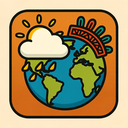
The icon in question is a masterful fusion of three distinct yet harmoniously interconnected themes: Weather, Globe, and Tribal. It stands as a symbolic representation not merely of geographical or meteorological data, but as an artistic narrative that weaves together humanity’s ancient relationship with the natural world, our global interconnectedness, and the enduring power of indigenous expression. Each element within this icon is intricately designed to reflect its core theme while contributing to a larger visual and cultural story.
At the center of the icon lies a stylized, three-dimensional globe that forms the foundational structure. Unlike conventional depictions of Earth, this globe is not rendered with photographic realism but instead appears as a hand-carved artifact—implying age, craftsmanship, and cultural reverence. The surface of the globe is textured with raised ridges resembling ancient cartographic lines or tribal ceremonial markings. Continents are outlined in bold, earth-toned pigments: deep ochre for Africa, burnt sienna for Asia, emerald green for South America. These colors echo natural pigments traditionally used in indigenous art and rituals.
What sets this globe apart is its integration of symbolic weather patterns directly onto its surface. Instead of flat color gradients or simplistic icons, the map is animated through a tactile overlay: storm systems appear as swirling spirals carved into the terrain; equatorial bands depict sunbursts; polar regions are etched with frost-like fractals suggesting ice caps and auroras. These aren't merely decorative—they are meant to represent climate zones, seasonal shifts, and atmospheric phenomena across the planet. The globe becomes a living map of Earth's weather dynamics, transforming geography into a dynamic story of climate.
The weather aspect is not confined to the surface—it radiates outward in all directions as an ethereal energy field. Encircling the globe like a halo are stylized elements representing wind, rain, sunlight, and storm clouds. These are depicted using flowing lines reminiscent of tribal body art or ancestral tattoos. For instance:
- Wind: Represented by undulating bands in deep indigo and charcoal, suggesting gusts that crisscross the globe like ritualistic pathways.
- Rain: Depicted as teardrop-shaped droplets with intricate internal patterns—each drop resembling a miniature tribal motif, symbolizing life-giving nourishment from above.
- Sunlight: A radiant sunburst emerges from the top of the globe, its rays formed by interlocking geometric shapes akin to those found in Navajo sand paintings or Maori koru patterns. The light pulses gently, indicating diurnal cycles and solar energy.
- Storms: Dark thunderclouds spiral around the poles and equatorial regions, their forms resembling traditional masks or ancestral faces—eyes wide open as if watching over the planet.
These weather elements are not static; they interact with one another. Rain falls from clouds that are partially drawn from wind patterns, while sunlight breaks through stormy veils in a manner evoking both natural phenomena and spiritual revelation. The entire icon breathes—suggesting that weather is not an isolated event but an ongoing dialogue between Earth and sky.
The most striking feature of the icon, however, lies in its tribal aesthetic—an intentional celebration of indigenous artistry from around the world. Every line, shape, and hue is infused with cultural symbolism. The patterns on the globe are not random; they are inspired by real-world traditions: Yoruba adinkra symbols (representing protection and wisdom), Inuit throat-singing rhythms translated into waveforms, Aboriginal dot painting techniques visualizing celestial navigation.
At the base of the icon, where the globe meets a circular pedestal, lies a mandala-like arrangement of tribal motifs. These are not mere ornaments—they form a kind of sacred geometry that binds all elements together. The patterns serve as both aesthetic flourish and cultural statement: they remind viewers that weather patterns have been understood and revered by indigenous communities for millennia through oral traditions, star maps, seasonal ceremonies, and ancestral knowledge.
The color palette is earth-based—ochres, umbers, charcoal blacks, terracotta reds—avoiding synthetic or digital tones. This choice reinforces the icon’s tribal roots. Even the lines are uneven and slightly irregular; they bear the marks of human hands rather than machine precision. It evokes hand-drawn maps from pre-colonial civilizations or ceremonial objects passed down through generations.
What makes this icon truly powerful is how seamlessly Weather, Globe, and Tribal converge. The globe is not just a planet—it is the stage upon which weather unfolds, shaped by global systems and cultural perception. Weather is not merely data—it becomes an expression of tribal wisdom, a manifestation of ancestral understanding. And tribal artistry becomes more than decoration; it acts as a bridge between science and spirit, between modern meteorology and ancient cosmology.
This icon is not meant for passive viewing. It invites contemplation: How do we understand the weather? Who holds the knowledge of Earth’s rhythms? What can we learn from cultures that have lived in harmony with nature for thousands of years? In a world facing climate change and environmental crisis, this icon serves as both a warning and a guide—a reminder that our planet's health is not just scientific but deeply cultural, spiritual, and communal.
Ultimately, the icon stands as a call to unity: to see weather not as an abstract force, but as part of a living globe shaped by human heritage. It tells us that understanding Earth’s climate begins with listening—not just to satellites and data streams, but also to the stories passed down through tribal elders, the patterns drawn in sand and on stone, and the rhythms of nature that have sustained life since time began.
Create your own icon with our GoGPT AI prompt:
GoGPT