

Weather Moon Digital glitch Free icon download
Download all to grab every PNG variant.
```html
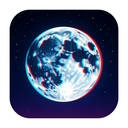
The icon is a visually complex and conceptually rich representation that masterfully fuses three distinct elements—Weather, the ethereal Moon, and the chaotic aesthetic of a Digital Glitch—into a single, cohesive design. At first glance, it appears as an abstract digital artwork that evokes both futuristic technology and natural phenomena, creating an intriguing duality between artificial systems and celestial forces.
The central focus of the icon is a stylized, crescent-shaped Moon that occupies the upper-left quadrant of the composition. The Moon is rendered with a soft, translucent gradient that transitions from deep indigo at its outer edges to cool silver at its core, giving it an almost luminous quality despite being in darkness. Unlike traditional depictions of the Moon, this version features subtle craters and surface textures—etched with a delicate line work that suggests topographical detail—but these features are fragmented and distorted by digital interference. The Moon's surface is not smooth; instead, its texture appears pixelated in certain areas while simultaneously showing signs of data corruption: jagged lines, color bleeding, and random shifts in brightness that mimic the visual artifacts of corrupted digital files.
Surrounding the Moon are dynamic Weather elements that flow outward from its center like ripples across a digital canvas. These are not conventional clouds or raindrops but rather abstract representations of atmospheric conditions rendered through glitch art techniques. Wisps of translucent vapor—shifting between shades of gray, pale blue, and electric cyan—emerge from the Moon’s edge in jagged patterns that suggest wind currents or storm systems. Some strands fragment into pixelated particles that drift downward like digital snowflakes, while others twist into spirals reminiscent of atmospheric vortices or storm fronts. The overall effect is as if weather itself were a form of data streaming from the Moon’s surface, where meteorological phenomena are not governed by physics but by corrupted code and random algorithms.
What truly defines this icon, however, is the pervasive presence of Digital Glitch effects. These are not mere decorative flourishes; they are integral to the icon’s meaning and visual language. The entire composition appears to be in a state of instability—constantly flickering between states of coherence and chaos. Lines that should be smooth abruptly break into stuttering segments, colors bleed across boundaries they shouldn’t cross, and entire sections of the Moon or weather patterns appear to "jump" or "re-render" mid-frame. These glitches are not random; they are strategically placed to suggest a system under strain—perhaps a weather prediction model powered by lunar data that has become corrupted.
One particularly striking glitch effect occurs in the lower-right corner, where the Moon’s reflected image in an otherwise clear digital "sky" dissolves into static-like noise. The reflection is inverted and stretched as if seen through a broken mirror or corrupted screen buffer. At its edges, binary code—0s and 1s—flickers erratically, as though attempting to reconstruct itself but failing due to instability. This adds a layer of narrative: the Moon is not just passively observing the weather; it is actively influencing it through faulty data streams.
The icon’s color palette further reinforces its thematic depth. Dominated by deep space blacks and electric blues, it evokes both outer darkness and digital interfaces. Accents of neon magenta, lime green, and toxic yellow appear only in glitch zones—areas where data has broken down—creating a visual contrast between order (the Moon's calm surface) and disorder (the chaotic weather distortions). This juxtaposition suggests a tension between natural cycles and technological intervention.
Technically, the icon is designed for use across digital platforms—mobile apps, web interfaces, smartwatch displays—where its glitch aesthetic can be animated. When used in motion, the glitches pulse and flicker subtly over time: particles drift slowly downward while other areas "reset" with a brief flash of corrupted data. This dynamic quality enhances the sense that the icon is not static but alive—a living representation of a weather system governed by faulty lunar algorithms.
Ultimately, this icon transcends mere visual symbolism. It speaks to contemporary anxieties about technology's role in understanding nature, particularly in an era where climate modeling and space-based observations rely heavily on digital infrastructure. The Moon—once a symbol of natural cycles—becomes a source of corrupted data; weather patterns are no longer purely atmospheric but digital artifacts shaped by broken systems. In this way, the icon becomes a poetic metaphor: even celestial bodies can be compromised by our technological imperfections, and in that compromise, beauty and danger coexist.
```Create your own icon with our GoGPT AI prompt:
GoGPT