

Weather Satellite Steampunk Free icon download
Download all to grab every PNG variant.
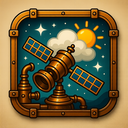
The icon in question is a breathtaking synthesis of futuristic meteorological technology, orbital observation systems, and the ornate aesthetic of steampunk artistry. At first glance, it appears as an intricate mechanical marvel suspended in midair—a satellite engineered not for modern digital networks or sleek aerospace engineering, but for the grand ambitions of a parallel 19th-century industrial revolution where steam-powered innovation reached into the very stratosphere. This icon embodies the convergence of three essential elements: Weather, Satellite, and Steampunk—each rendered with meticulous detail and symbolic depth. At its core, the icon represents a weather satellite—a device designed to monitor atmospheric conditions from orbit. But unlike conventional satellites with polished aluminum surfaces or solar panels, this one is crafted from polished brass, aged copper, wrought iron, and darkened steel. Its primary form is a large central orb resembling an oversized mechanical globe or compass rose; however, instead of being smooth and spherical like a real-world satellite dish or probe, it’s segmented into interlocking hexagonal plates with visible rivets and gear teeth embedded along the seams. These plates rotate slowly, like the cogs of an enormous clockwork engine, suggesting that the device is not only observing weather but actively analyzing atmospheric data through complex mechanical computation. The globe itself displays a detailed topographic and meteorological map of Earth—etched by hand into its surface with fine engravings. Cloud formations are depicted as swirling copper filigree patterns, their edges flared like flame or smoke, suggesting both atmospheric movement and the presence of steam-driven propulsion mechanisms. Storm systems are illustrated in deep reds and oranges, resembling glowing embers inside a furnace; high-pressure zones appear as cool blue rings with concentric bands reminiscent of pressure gauges. At the poles, delicate filaments extend outward—thin brass wires that resemble lightning rods or antennae—which pulse faintly with amber light when depicting storm activity. Radiating from the central globe are several elongated appendages: telescoping arms made of segmented brass tubing, each joint equipped with a tiny gear system that allows for minute adjustments in orientation. At the end of each arm is a device resembling an old-fashioned barometer or hygrometer, but vastly scaled up and reimagined as functional weather sensors. One features a rotating dial encased in glass—its needle trembling between "Tornado" and "Calm." Another has a series of small, spinning turbine blades powered not by wind but by controlled bursts of steam released from hidden valves. These are not mere decorative elements; they function as mechanical anemometers, humidity indicators, and atmospheric pressure transmitters—all driven by the satellite's internal clockwork engine. The base of the icon is shaped like a circular platform—crafted from riveted iron plates resembling those found in old factory machinery or steam locomotives. Upon it sit three large brass wheels with cogs that interlock seamlessly, turning slowly to maintain balance and stability in orbit. These wheels are not for propulsion, but rather symbolic: they represent the cyclical nature of weather patterns—seasons turning, storms forming and dissipating—mechanically encoded through perpetual motion. A prominent feature of the icon is its central core—a glowing orb housed within a transparent glass dome resembling a Victorian-era gas lantern. This orb pulses softly with changing hues: blue for clear skies, green for mild conditions, yellow for heatwaves, and deep crimson when extreme weather alerts are triggered. The light flickers in rhythm with simulated wind gusts or thunderclaps heard faintly in the background of the icon’s visual narrative. Inside this glowing sphere lies a miniature mechanical storm system—a tiny rotating vortex of brass feathers and spun copper threads that simulate cloud movement. The entire structure is supported by a complex network of brass chains, suspension cables, and articulated struts—reminiscent of those seen on early airships or floating observatories from alternate-history novels. These support systems are not just structural; they contain small gauges, dials, and levers that the artist has included for narrative depth. One lever is labeled "Atmospheric Density," another "Thermal Gradient," while a third reads simply “Weather Oracle.” All of them are fully functional within the icon’s symbolic universe. In true steampunk fashion, every element serves dual purposes—both aesthetic and metaphorical. The satellite does not merely collect weather data; it interprets it through mechanical intuition, much like a 19th-century natural philosopher might have predicted storms based on subtle changes in barometric pressure or bird flight patterns. The icon evokes a world where meteorology is an art form, where atmospheric science is not just measured but *experienced* through gears, steam vents, and ticking pendulums. Moreover, the icon reflects a deep romanticism toward industrial progress—where technology is beautiful not despite its complexity but because of it. Every rivet tells a story; every exposed pipe hints at hidden power. The satellite is less an instrument of modern surveillance and more a celestial orator—one that speaks in the language of gears and steam about the Earth's ever-changing moods. In essence, this icon transcends mere representation. It encapsulates a vision where weather prediction is not a digital algorithm but an intricate dance of mechanical precision and human imagination. The fusion of Weather, Satellite, and Steampunk creates not just an emblem, but a story—a chronicle of how humanity once dreamed of watching the sky with brass eyes and listening to the wind through copper ears. This is more than a symbol. It is a machine-meditation on nature’s rhythm, forged in fire and time.
Create your own icon with our GoGPT AI prompt:
GoGPT