

Weather Tree Iconic Free icon download
Download all to grab every PNG variant.
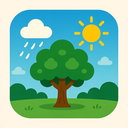
At the intersection of nature’s enduring symbolism and modern digital design lies a truly iconic creation—an emblem that seamlessly fuses the elements of weather, tree, and universal recognition into a single visual masterpiece. This is not merely an icon; it is a narrative in minimalist form, telling stories of climate cycles, ecological balance, and human connection with the natural world. The "Weather-Tree Icon" stands as one of the most compelling examples of contemporary iconography where aesthetic elegance meets functional clarity.
At its core, this iconic symbol draws its identity from the tree—an age-old emblem representing life, growth, resilience, and interconnectedness. In ancient cultures across continents—from the Norse Yggdrasil to the sacred Bodhi Tree in Buddhism—the tree has served as a universal metaphor for existence itself. The icon captures this essence by portraying a stylized but recognizable tree: its trunk sturdy and grounded like the earth’s foundation, its branches extending gracefully into an open sky, suggesting both upward aspiration and deep roots. But what elevates this design beyond traditional botanical imagery is the integration of dynamic weather elements directly within the tree's form.
The transformation occurs when subtle yet deliberate weather motifs are woven into every aspect of the tree’s silhouette. The leaves are not uniform in color or shape; instead, they transition from lush green at the base to pale yellow and soft amber near the top—representing seasonal change, a hallmark of climatic patterns across temperate zones. At certain points along the branches, delicate mist or faint rain droplets hang in midair, suggesting humidity or an approaching storm. The sky above is not merely a background but an active participant: soft gradient hues depict a transitioning atmosphere from clear blue to twilight gray, with thin cloud formations shaped like wisps of breath—subtle hints of wind and shifting pressure systems.
What makes this icon truly iconic is its ability to communicate complex meteorological concepts at a glance. A small sunbeam piercing through the canopy can denote fair weather or solar intensity, while a gentle breeze is implied by the slight curve in the upper branches and leaves swaying as if caught in an invisible current. In colder variations of the same icon, frost patterns appear on select leaves, and snowflakes—minimalist and geometric—drift down from the upper limbs like silent confetti. Each variation speaks to different weather conditions without overcomplicating visual language—a hallmark of effective icon design.
Designers who crafted this iconic piece employed principles of visual harmony, balance, and symbolic depth. The tree's form follows natural symmetry but allows for asymmetrical weather details to convey unpredictability—mirroring how real-world climate systems behave. The use of color is both strategic and emotionally resonant: greens signify health and vitality, blues represent calm or precipitation, yellows denote warmth or heat stress, while grays and whites suggest overcast conditions or cold fronts. This careful palette ensures that the icon remains intuitive across diverse audiences regardless of linguistic background.
Functionally, the Weather-Tree Icon is designed for digital environments—weather applications, environmental dashboards, educational platforms, and eco-conscious branding. In a smartphone app, when users tap on this icon, they are not just viewing data; they are engaging with a visual poem that connects them to nature’s rhythms. It fosters emotional resonance by reminding individuals of their dependence on ecological stability and the delicate balance of weather patterns that sustain life.
Furthermore, its iconic status stems from its adaptability. The same core design can be modified for different contexts: a drought alert might show dry, cracked leaves; a storm warning could feature lightning streaks subtly integrated into the trunk; during high pollen counts, faint particle lines drift from the foliage. These variations preserve the icon’s integrity while expanding its utility across climate science, public health warnings, and environmental awareness campaigns.
Perhaps most significantly, this icon transcends mere functionality. It represents a philosophy—an invitation to see weather not as an abstract phenomenon but as part of an ongoing conversation between humanity and nature. By anchoring the concept of weather in the enduring image of a tree, it reinforces that climate is not separate from life but deeply interwoven with it. In an age marked by environmental challenges, such icons serve as both tools and talismans: reminders to observe, understand, and protect the fragile systems that support us.
In conclusion, the Weather-Tree Icon stands as a triumph of modern design philosophy. It exemplifies how deeply symbolic forms—when rooted in nature (tree), informed by scientific observation (weather), and refined through artistic vision (iconic)—can create powerful visual language that speaks to minds and hearts alike. It is not just a representation of data but an emblem of connection, sustainability, and mindful coexistence. As climate awareness grows globally, icons like this will continue to play vital roles—not only in communication but in shaping how we perceive our place within the living world.
Create your own icon with our GoGPT AI prompt:
GoGPT